


Page 200 - A GRAMMAR OF BHOJPURI _ PhD Dissertation 2020 TU
P. 200
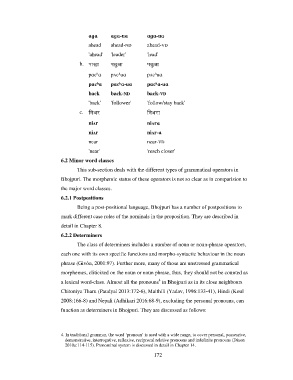
ɑɡɑ ɑɡɑ-uɑ ɑɡɑ-uɑ
ahead ahead-ND ahead-VD
'ahead' 'leader' 'lead'
b. पाछा पछुआ पछुआ
pɑcʰɑ pʌcʰuɑ pʌcʰuɑ
pɑcʰɑ pɑcʰɑ-uɑ pɑcʰɑ-uɑ
back back-ND back-VD
'back' 'follower' 'follow/stay back'
c. िनअर िनअरा
niʌr niʌrɑ
niʌr niʌr-ɑ
near near-VD
'near' 'reach closer'
6.2 Minor word classes
This sub-section deals with the different types of grammatical operators in
Bhojpuri. The morphemic status of these operators is not so clear as in comparision to
the major word classes.
6.2.1 Postpositions
Being a post-positional language, Bhojpuri has a number of postpositions to
mark different case roles of the nominals in the proposition. They are described in
detail in Chapter 8.
6.2.2 Determiners
The class of determiners includes a number of noun or noun-phrase operators,
each one with its own specific functions and morpho-syntactic behaviour in the noun
phrase (Givón, 2001:97). Further more, many of those are unstressed grammatical
morphemes, cliticized on the noun or noun phrase, thus, they should not be counted as
4
a lexical word-class. Almost all the pronouns in Bhojpuri as in its close neighbours
Chitoniya Tharu (Paudyal 2013:172-6), Maithili (Yadav, 1996:133-41), Hindi (Koul
2008:166-8) and Nepali (Adhikari 2016:68-9), excluding the personal pronouns, can
function as determiners in Bhojpuri. They are discussed as follows:
4. In traditional grammar, the word pronoun is used with a wide range, to cover personal, possessive,
demonstrative, interrogative, reflexive, reciprocal relative pronouns and indefinite pronouns (Dixon
2010a:114-115). Pronominal system is discussed in detail in Chapter 14.
172

