


Page 159 - A GRAMMAR OF BHOJPURI _ PhD Dissertation 2020 TU
P. 159
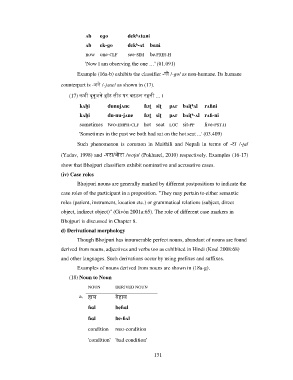
ʌb eɡo dekʰʌtɑni
ʌb ek-ɡo dekʰ-ʌt bɑni
now one-CLF see-SIM be.PRES.H
'Now I am observing the one
' (01.091)
Example (16a-b) exhibits the classifier -गो /-ɡo/ as non-humane. Its humane
counterpart is -जने /-jʌne/ as shown in (17).
(17) कभी दूनूजने हॉट सीट पर बइठल रहनी ... ।
kʌb ̤ i dunujʌne ɦɔʈ siʈ pʌr bʌiʈʰʌl rʌɦni
kʌb ̤ i du-nu-jʌne ɦɔʈ siʈ pʌr bʌiʈʰ-ʌl rʌɦ-ni
sometimes two-EMPH-CLF hot seat LOC sit-PP live-PST.H
'Sometimes in the past we both had sat on the hot seat ...' (03.409)
Such phenomenon is common in Maithili and Nepali in terms of -टा /-ʈɑ/
(Yadav, 1998) and -वटा/ओटा /woʈɑ/ (Pokharel, 2010) respectively. Examples (16-17)
show that Bhojpuri classifiers exhibit nominative and accusative cases.
(iv) Case roles
Bhojpuri nouns are generally marked by different postpositions to indicate the
case roles of the participant in a proposition. "They may pertain to either semantic
roles (patient, instrument, location etc.) or grammatical relations (subject, direct
object, indirect object)" (Givón 2001a:65). The role of different case markers in
Bhojpuri is discussed in Chapter 8.
d) Derivational morphology
Though Bhojpuri has innumerable perfect nouns, abundant of nouns are found
derived from nouns, adjectives and verbs too as exhibited in Hindi (Koul 2008:68)
and other languages. Such derivations occur by using prefixes and suffixes.
Examples of nouns derived from nouns are shown in (18a-g).
(18) Noun to Noun
NOUN DERIVED NOUN
a. हाल बेहाल
ɦɑl beɦɑl
ɦɑl be-ɦʌl
condition NEG-condition
'condition' 'bad condition'
131

