


Page 155 - A GRAMMAR OF BHOJPURI _ PhD Dissertation 2020 TU
P. 155
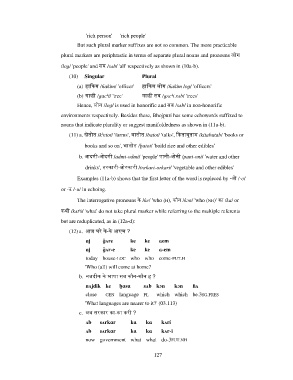
'rich person'   'rich people'
                                 But such plural marker suffixes are not so common. The more practicable

                           plural markers are periphrastic in terms of separate plural nouns and pronouns लोग

                           /loɡ/ 'people' and सब /sʌb/ 'all' respectively as shown in (10a-b).
                              (10)     Singular             Plural

                                 (a) हा6कम /ɦɑkim/ 'officer'   हा6कम लोग /ɦɑkim loɡ/ 'officers'
                                 (b) गाछी /ɡɑcʰi/ 'tree'     गाछी सब /ɡʌcʰi sʌb/ 'trees'

                                 Hence, लोग /loɡ/ is used in honorific and सब /sʌb/ in non-honorific

                           environments respectively. Besides these, Bhojpuri has some echowords suffixed to
                           nouns that indicate plurality or suggest manifoldedness as shown in (11a-b).

                              (11) a. खेतोत /kʰetot/ 'farms', बातोत /bɑtot/ 'talks', 6कताबुताब /kitɑbutɑb/ 'books or

                                      books and so on', भातोत /b ̤ ɑtot/ 'boild rice and other edibles'
                                  b. आदमी-ओदमी /ɑdmi-odmi/ 'people' पानी-ओनी /pɑni-oni/ 'water and other

                                     drinks', तरकारी-ओरकारी /tʌrkɑri-orkɑri/ 'vegetable and other edibles'

                                 Examples (11a-b) shows that the first letter of the word is repleced by -ओ /-o/

                           or -उ /-u/ in echoing.
                                 The interrogative pronouns के /ke/ 'who (H), कौन /kɔn/ 'who (NH)' का /kɑ/ or

                           कथी /kʌtʰi/ 'what' do not take plural marker while referring to the multiple referents

                           but are reduplicated, as in (12a-d):

                              (12) a.  आज घरे के-के आएम ?
                                     ɑj     ɡ ̈ ʌre     ke   ke    ɑem
                                     ɑj     ɡ ̈ ʌr-e    ke   ke    ɑ-em

                                     today  house-LOC  who  who  come-FUT.H
                                     'Who (all) will come at home?

                                  b.  नजदीक के भाषा सब कौन-कौन ह ?
                                     nʌjdik  ke    b ̤ ɑsɑ   sʌb  kɔn     kɔn     ɦʌ
                                     close   GEN  language  PL    which  which  be.3SG.PRES
                                     'What languages are nearer to it?' (03.113)

                                  c.  अब सरकार का-का करी ?

                                     ʌb    sʌrkɑr       kɑ    kɑ    kʌri
                                     ʌb    sʌrkɑr       kɑ    kɑ    kʌr-i
                                     now  government  what  what  do-3FUT.NH


                                                                    127

