


Page 151 - A GRAMMAR OF BHOJPURI _ PhD Dissertation 2020 TU
P. 151
CHAPTER 6
                                                         WORD CLASSES

                           6.0  Outline
                                 This chapter deals with word classes (lexicon) in Bhojpuri. It comprises in
                           three sections. In section 6.1, the major lexical word classes are described with their

                           chief properties. Section 6.2 exhibits properties of the minor word classes in the
                           language and we summarize the findings in the chapter in section 6.3.

                           6.1 Major word classes
                                 Givón (2001a:49) classifies nouns, adjectives, verbs and adverbs as the major

                           lexical word classes what Bhojpuri also exhibits. They are characterized by three
                           properties: semantic, morphological and syntactic. We discuss the properties as follows:

                           6.1.1 Properties of nouns
                           a) Semantic properties of nouns
                                 As Chitoniya Tharu (Paudyal 2013:90), Nepali (Adhikari 2016:32),  and other

                           natural languages exhibit, Bhojpuri nouns may be characterized and distinguished
                           from other word classes in terms of stability, complexity, concreteness, compactness

                           and countability. The prototypical Bhojpuri nouns in (1a-h) exhibit these properties.
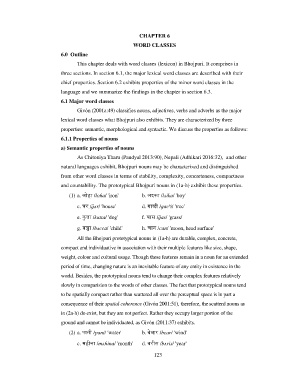
                              (1) a. लोहा /loɦɑ/ 'iron'      b. लइका /lʌikɑ/ 'boy'

                                 c. घर /ɡ ̈ ʌr/ 'house'      d. गाछी /ɡɑcʰi/ 'tree'

                                 e. कु#ा /kuttɑ/ 'dog'      f. घास /ɡ ̈ ɑs/ 'grass/
                                 g. ब'ा /bʌccɑ/ 'child'     h. चान /cɑn/ 'moon, head surface'


                                 All the Bhojpuri prototypical nouns in (1a-h) are durable, complex, concrete,
                           compact and individuative in association with their multiple features like size, shape,
                           weight, colour and cultural usage. Though these features remain in a noun for an extended

                           period of time, changing nature is an inevitable feature of any entity in existence in the
                           world. Besides, the prototypical nouns tend to change their complex features relatively

                           slowly in comparision to the words of other classes. The fact that prototypical nouns tend
                           to be spatially compact rather than scattered all over the perceptual space is in part a

                           consequence of their spatial coherence (Givón 2001:51), therefore, the scatterd nouns as
                           in (2a-h) do exist, but they are not perfect. Rather they occupy larger portion of the

                           ground and cannot be individuated, as Givón (2011:37) exhibits.
                              (2) a. पानी /pɑni/ 'water'     b. बेआर /be ɑr/ 'wind'

                                 c. महीना /mʌɦinɑ/ 'month'    d. बरीस /bʌris/ 'year'

                                                                    123

