


Page 156 - A GRAMMAR OF BHOJPURI _ PhD Dissertation 2020 TU
P. 156
'What (all) will the government do now?
                                  d.  तू कथी-कथी िखअइबऽ ?

                                     tu      kʌtʰi  kʌtʰi  kʰiʌibʌ
                                     tu      kʌtʰi  kʌtʰi  kʰiɑ-i   bʌ

                                     2.NOM  what  what  feed-FUT  be.2FUT.MH
                                     'What (all) will you have me eat?'

                                 In examples (12a-d) the reduplicated question words encode the sense of
                           plurality.

                           (ii) Gender
                                 Like its number system, Bhojpuri has two genders: masculine and feminine

                           (Grierson 1884a:1-7, Ojha 1915[1982]:7-10, Tiwari 1954:413 and 1960:105,
                           Shrivastava 1999:44, Sharma and Ashk 2007:29, Singh 2009:80 and 2013:80 and
                           Thakur 2011:56) as exhibited in Chitoniya Tharu (Paudyal 2013:102), Maithili

                           (Yadav 1996:63), Awadhi (Saksena 1937/1971:112), Hindi (Koul 2008:33) and
                           Nepali (Adhikari 2016:33). They are morphological, lexical and grammatical though

                           dropped eastwards as in Maithili (Yadav 1996:63). Regarding morphological change,
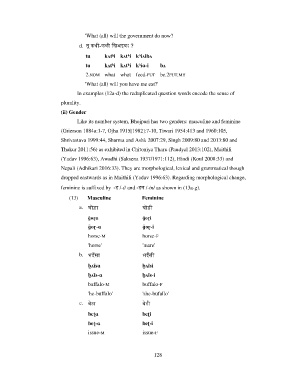
                           feminine is suffixed by  -इ /-i/ and -इन /-in/ as shown in (13a-g).

                              (13)       Masculine          Feminine

                                  a.  घोड़ा                   घोड़ी
                                      ɡ ̈ oɽɑ                ɡ ̈ oɽi

                                      ɡ ̈ oɽ-ɑ               ɡ ̈ oɽ-i
                                      horse-M                horse-F
                                      'horse'                'mare'

                                  b.  भइँसा                  भइँसी

                                      b ̤ ʌĩsɑ               b ̤ ʌĩsi
                                      b ̤ ʌĩs-ɑ              b ̤ ʌĩs-i

                                      buffalo-M              buffalo-F
                                      'he-buffalo'           'she-bufallo'

                                  c.  बेटा                   बेटी
                                      beʈɑ                   beʈi

                                      beʈ-ɑ                  beʈ-i
                                      issue-M                issue-F


                                                                    128

