


Page 158 - A GRAMMAR OF BHOJPURI _ PhD Dissertation 2020 TU
P. 158
tẽ        ʌilis/e
                                    tẽ        ɑ-il-is/e
                                    2SG.NOM  come-PP-2.PST

                                    'You came.' (non-honorific)
                                 b.  तू समझलऽ ।

                                    tu        sʌmʌȷ ̈ lʌ
                                    tu        sʌmʌȷ ̈ -ʌl-ʌ
                                    2SG.NOM  understand-PP-2.PST.MH

                                    'You understood.' (mid-honorific-masculine) (06.044)
                                 c.  तू समझलू ।

                                    tu        sʌmʌȷ ̈ lu
                                    tu        sʌmʌȷ ̈ -ʌl-u
                                    2SG.NOM  understand-PP-2.PST.F.MH
                                    'You understood.' (mid-honorific-feminine)

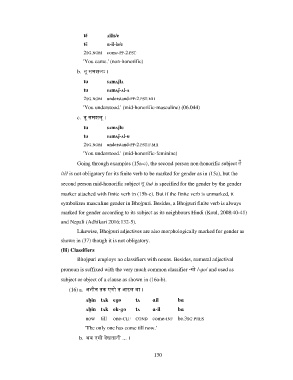
                                 Going through examples (15a-c), the second person non-honorific subject तेँ

                           /tẽ/ is not obligatory for its finite verb to be marked for gender as in (15a), but the
                           second person mid-honorific subject तू /tu/ is specified for the gender by the gender

                           marker attached with finite verb in (15b-c). But if the finite verb is unmarked, it
                           symbolizes masculine gender in Bhojpuri. Besides, a Bhojpuri finite verb is always

                           marked for gender according to its subject as its neighbours Hindi (Koul, 2008:40-41)
                           and Nepali (Adhikari 2016:132-5).

                                 Likewise, Bhojpuri adjectives are also morphologically marked for gender as
                           shown in (37) though it is not obligatory.

                           (iii) Classifiers
                                 Bhojpuri employs no classifiers with nouns. Besides, numeral adjectival

                           pronoun is suffixed with the very much common classifier -गो /-ɡo/ and used as
                           subject or object of a clause as shown in (16a-b).

                              (16) a.  अभीन तक एगो त आइल बा ।

                                     ʌb ̤ in  tʌk  eɡo    tʌ     ɑil       bɑ
                                     ʌb ̤ in  tʌk  ek-ɡo   tʌ    ɑ-il      bɑ
                                     now  till  one-CLF  COND  come-INF  be.3SG.PRES

                                     'The only one has come till now.'

                                  b.  अब एगो देखतानी ... ।


                                                                    130

