


Page 154 - A GRAMMAR OF BHOJPURI _ PhD Dissertation 2020 TU
P. 154
1
                           terms of their morphology.  However, they may be inflected in terms of number,
                           gender, classifiers and case role of the referent.

                           (i) Number
                                 As exhibited in its close neighbours Chitoniya Tharu (Paudyal 2013:105),
                           Maithili (Yadav 1996:69), Awadhi (Saksena 1937/1971:115), Hindi (Koul 2008:35)

                           and Nepali (Adhikari 2016:33); Bhojpuri has two numbers: singular and plural
                           (Grierson 1883:25, Ojha 1915[1982]:5, Tiwari 1954:415 and 1960:106, Nirbhik

                           1975:62, Tripathy 1987:193, Sharma and Ashk 2007:32, Shrivastava 1999:46, Singh
                           2009:86 and 2013:84 and Thakur 2011:60). The verb agrees with the nominal subject
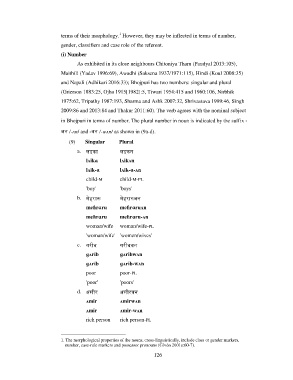
                           in Bhojpuri in terms of number. The plural number in noun is indicated by the suffix -


                           अन /-ʌn/ and -वन /-wʌn/ as shown in (9a-d).
                              (9)       Singular         Plural

                                 a.  लइका          लइकन
                                     lʌikɑ         lʌikʌn

                                     lʌik-ɑ        lʌik-ɑ-ʌn
                                     child-M       child-M-PL

                                     'boy'         'boys'
                                 b.  मेहरा=        मेहरा>अन

                                     meɦrɑru       meɦrɑruʌn
                                     meɦrɑru       meɦrɑru-ʌn
                                     woman/wife    woman/wife-PL

                                     'woman/wife'  'women/wives'
                                 c.  गरीब          गरीबवन

                                     ɡʌrib         ɡʌribwʌn
                                     ɡʌrib         ɡʌrib-wʌn

                                     poor          poor-PL
                                     'poor'        'poors'
                                 d.  अमीर          अमीरवन

                                     ʌmir          ʌmirwʌn
                                     ʌmir          ʌmir-wʌn

                                     rich person   rich person-PL


                           1. The morphological properties of the nouns, cross-linguistically, include class or gender markers,
                            number, case-role markers and possessor pronouns (Givón 2001a:60-7).
                                                                    126

