


Page 152 - A GRAMMAR OF BHOJPURI _ PhD Dissertation 2020 TU
P. 152
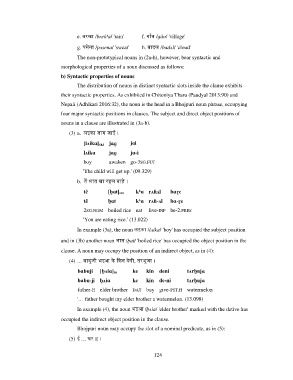
e. बरखा /bʌrkʰɑ/ 'rain' f. गाँव /ɡɑo/ 'village'
̃
g. पसेना /pʌsenɑ/ 'sweat' h. बादल /bɑdʌl/ 'cloud'
The non-prototypical nouns in (2a-h), however, bear syntactic and
morphological properties of a noun discussed as follows:
b) Syntactic properties of nouns
The distribution of nouns in distinct syntactic slots inside the clause exhibits
their syntactic properties. As exhibited in Chitoniya Tharu (Paudyal 2013:90) and
Nepali (Adhikari 2016:32), the noun is the head in a Bhojpuri noun phrase, occupying
four major syntactic positions in clauses. The subject and direct object positions of
nouns in a clause are illustrated in (3a-b).
(3) a. लइका जाग जाई ।
[lʌikɑ] SBJ jɑɡ jɑi
lʌikɑ jɑɡ jɑ-i
boy awaken go-3SG.FUT
'The child will get up.' (09.329)
b. त) भात खा रहल बाड़े ।
tẽ [b ̤ ɑt] DO kʰɑ rʌɦʌl bɑɽe
tẽ b ̤ ɑt kʰɑ rʌɦ-ʌl bɑ-ɽe
2SG.NOM boiled rice eat live-INF be-2.PRES
'You are eating rice.' (13.022)
In example (3a), the noun लइका /lʌikɑ/ 'boy' has occupied the subject position
and in (3b) another noun भात /b ̤ ɑt/ 'boiled rice' has occupied the object position in the
clause. A noun may occupy the position of an indirect object, as in (4):
(4) ... बाबुजी भइआ के 6कन देनी, तरभूजा ।
bɑbuji [b ̤ ʌiɑ] IO ke kin deni tʌrb ̤ ujɑ
bɑbu-ji b ̤ ʌiɑ ke kin de-ni tʌrb ̤ ujɑ
father-H elder brother DAT buy give-PST.H watermelon
'
father bought my elder brother a watermelon. (13.098)
In example (4), the noun भइआ /b̤ ʌiɑ/ 'elder brother' marked with the dative has
occupied the indirect object position in the clause.
Bhojpuri noun may occupy the slot of a nominal predicate, as in (5):
(5) ई ... घर ह ।
124

