


Page 147 - A GRAMMAR OF BHOJPURI _ PhD Dissertation 2020 TU
P. 147
5.3.5 Processes involving assimilation
The following processes are common as in other languages to involve
assimilation in Bhojpuri.
a) Consonants
(i) Intervocalic voicing
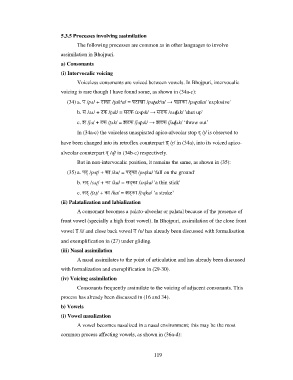
Voiceless consonants are voiced between vowels. In Bhojpuri, intervocalic
voicing is rare though I have found some, as shown in (34a-c):
(34) a. प /pʌ/ + टाखा /ʈɑkʰɑ/ = पटाखा /pʌʈɑkʰɑ/ → पड़ाका /pʌɽɑkɑ/ 'explosive'
b. स /sʌ/ + टक /ʈʌk/ = सटक /sʌʈʌk/ → सडक /sʌɖʌk/ 'shut up'
c. झ /ȷ ̈ ʌ/ + टक /ʈʌk/ = झटक /ȷ ̈ ʌʈʌk/ → झडक /ȷ ̈ ʌɖʌk/ throw out
In (34a-c) the voiceless unaspirated apico-alveolar stop ट् /ʈ/ is observed to
have been changed into its retroflex counterpart ड़् /ɽ/ in (34a), into its voiced apico-
alveolar counterpart ड् /ɖ/ in (34b-c) respectively.
But in non-intervocalic position, it remains the same, as shown in (35):
(35) a. पट् /pʌʈ/ + का /kɑ/ = प"का /pʌʈkɑ/ 'fall on the ground'
b. सट् /sʌʈ/ + का /kɑ/ = स"का /sʌʈkɑ/ 'a thin stick'
c. झट् /ȷ ̈ ʌʈ/ + का /kɑ/ = झ"का /ȷ ̈ ʌʈkɑ/ a stroke
(ii) Palatalization and labialization
A consonant becomes a palato-alveolar or palatal because of the presence of
front vowel (specially a high front vowel). In Bhojpuri, assimilation of the close front
vowel इ /i/ and close back vowel उ /u/ has already been discussed with formalisation
and exemplification in (27) under gliding.
(iii) Nasal assimilation
A nasal assimilates to the point of articulation and has already been discussed
with formalization and exemplification in (29-30).
(iv) Voicing assimilation
Consonants frequently assimilate to the voicing of adjacent consonants. This
process has already been discussed in (16 and 34).
b) Vowels
(i) Vowel nasalization
A vowel becomes nasalized in a nasal environment; this may be the most
common process affecting vowels, as shown in (36a-d):
119

