Page 144 - A GRAMMAR OF BHOJPURI _ PhD Dissertation 2020 TU
P. 144
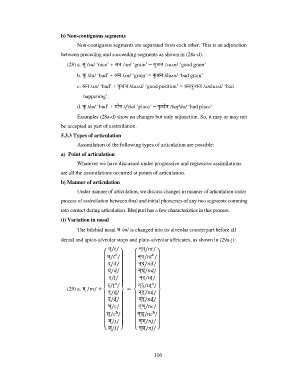
b) Non-contiguous segments
                                 Non-contiguous segments are separated from each other. This is an adjunction

                           between preceding and succeeding segments as shown in (28a-d).
                             (28) a. सु /su/ ‘nice’ + अन /ʌn/ ‘grain’ = सुअन /suʌn/ ‘good grain’

                                 b. कु /ku/ ‘bad’ + अन /ʌn/ ‘grain’ = कुअन /kuʌn/ ‘bad grain’

                                 c. अन /ʌn/ ‘bad’ + कुशल /kusʌl/ ‘good position’ = अनकुशल /ʌnkusʌl/ ‘bad

                                    happening’.
                                 d. कु /ku/ ‘bad’ + ठाँव /ʈʰɑo/ ‘place’ = कुठाँव /kuʈʰɑo/ ‘bad place’
                                                                             ̃
                                                        ̃
                                 Examples (28a-d) show no changes but only adjunction. So, it may or may not
                           be accepted as part of assimilation.

                           5.3.3 Types of articulation
                                 Assimilation of the following types of articulation are possible:

                           a)  Point of articulation
                                 Whatever we have discussed under progressive and regressive assimilations
                           are all the assimilations occurred at points of articulation.

                           b) Manner of articulation
                                 Under manner of articulation, we discuss changes in manner of articulation under

                           process of assimilation between final and initial phonemes of any two segments comming
                           into contact during articulation. Bhojpuri has a few characteristics in this process.

                           (i) Variation in nasal
                                 The bilabial nasal म /m/ is changed into its alveolar counterpart before all

                           dental and apico-alveolar stops and plato-alveolar affricates, as shown in (29a-j):
                                              त्/'/        न् त्//'/
                                            ⎧      ⎫     ⎧         ⎫
                                            ⎪ थ्/'ʰ/ ⎪   ⎪ न् थ्//'ʰ/ ⎪
                                            ⎪ द्/(/  ⎪   ⎪  न् द्//(/ ⎪
                                            ⎪ ध्/(̤/ ⎪   ⎪ न् ध्//(̤/ ⎪
                                            ⎪  ट्/ʈ/  ⎪  ⎪  न् ट्//ʈ/  ⎪
                                            ⎪      ⎪     ⎪         ⎪
                             (29) a. म् /"/ +  ठ्/ʈʰ/   =   न् ठ्//ʈʰ/
                                            ⎨ ड्/ɖ/  ⎬   ⎨  न् ड्//ɖ/ ⎬
                                            ⎪ ढ्/ɖ̈/ ⎪   ⎪ न् ढ्//ɖ̈/ ⎪
                                            ⎪ च्/*/ ⎪    ⎪ न् च्//*/ ⎪
                                            ⎪      ⎪     ⎪         ⎪
                                            ⎪ छ्/*ʰ/ ⎪   ⎪ न् छ्//*ʰ/ ⎪
                                            ⎪  ज्/+/  ⎪  ⎪  न् ज्//+/  ⎪
                                            ⎩ झ्/+̈/ ⎭   ⎩ न् झ्//+̈/ ⎭


                                                                    116
   139   140   141   142   143   144   145   146   147   148   149