


Page 141 - A GRAMMAR OF BHOJPURI _ PhD Dissertation 2020 TU
P. 141
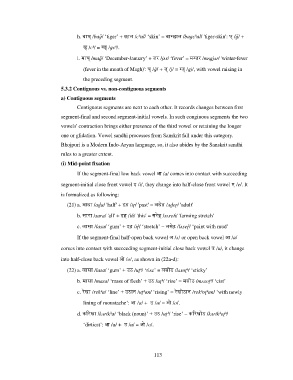
h. बाघ् /bɑɡ ̈ / tiger + छाल /cʰɑl/ skin = बाWछाल /bɑɡcʰɑl/ 'tiger-skin': घ् /ɡ ̈ / +
छ् /cʰ/ = Wछ् /ɡcʰ/.
i. माघ् /mɑɡ ̈ / December-January + जर /jʌr/ fever = मWजर /mʌɡjʌr/ 'winter-fever
(fever in the month of Magh)': घ् /ɡ ̈ / + ज् /j/ = Wज् /ɡj/, with vowel raising in
the preceding segment.
5.3.2 Contiguous vs. non-contiguous segments
a) Contiguous segments
Contiguous segments are next to each other. It records changes between first
segment-final and second segment-initial vowels. In such congiuous segments the two
vowels' contraction brings either presence of the third vowel or retaining the longer
one or glidation. Vowel sandhi processes from Sanskrit fall under this category.
Bhojpuri is a Modern Indo-Aryan language, so, it also abides by the Sanskrit sandhi
rules to a greater extent.
(i) Mid-point fixation
If the segment-final low back vowel आ /ɑ/ comes into contact with succeeding
segment-initial close front vowel इ /i/, they change into half-close front vowel ए /e/. It
is formalized as following:
(21) a. आधा /ɑd ̤ ɑ/ 'half' + इड़ /iɽ/ 'past' = अधेड़ /ʌd ̤ eɽ/ 'adult'
b. सारा /sɑrɑ/ 'all' + इह /iɦ/ 'this' = सरेह /sʌreɦ/ 'farming stretch'
c. लासा /lɑsɑ/ gum + इढ़ /iɽ̊ / stretch = लसेढ़ /lʌseɽ̊ / paint with mud
If the segment-final half-open back vowel अ /ʌ/ or open back vowel आ /ɑ/
comes into contact with succeeding segment-initial close back vowel उ /u/, it change
into half-close back vowel ओ /o/, as shown in (22a-d):
(22) a. लासा /lɑsɑ/ gum + उठ /uʈʰ/ rise = लसोठ /lʌsoʈʰ/ sticky
b. मासा /mɑsɑ/ mass of flesh + उठ /uʈʰ/ rise = मसोठ /mʌsoʈʰ/ cist
c. रेखा /rekʰɑ/ line + उठान /uʈʰɑn/ rising = रेखोठान /rekʰoʈʰɑn/ with newly
lining of moustache: आ /ɑ/ + उ /u/ = ओ /o/.
d. क0रखा /kʌrikʰɑ/ black (noun) + उठ /uʈʰ/ rise = क0रखोठ /kʌrikʰoʈʰ/
dirtiest: आ /ɑ/ + उ /u/ = ओ /o/.
113

