


Page 136 - A GRAMMAR OF BHOJPURI _ PhD Dissertation 2020 TU
P. 136
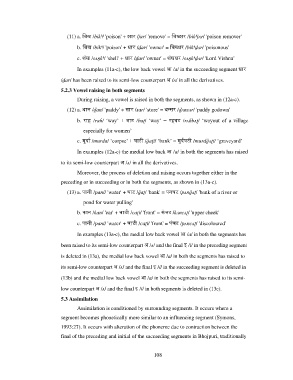
(11) a. िबख /bikʰ/ 'poison' + झार /ȷ ̈ ɑr/ 'remove' = िबGझर /bikʰȷ ̈ ʌr/ 'poison remover'
b. िबख /bikʰ/ 'poison' + धार /d ̤ ɑr/ 'owner' = िबGधर /bikʰd ̤ ʌr/ 'poisonous'
c. शंख /sʌŋkʰ/ 'shell' + धार /d ̤ ɑr/ 'owner' = शंखधर /sʌŋkʰd ̤ ʌr/ 'Lord Vishnu'
In examples (11a-c), the low back vowel आ /ɑ/ in the succeeding segment धार
/d ̤ ɑr/ has been raised to its semi-low counterpart अ /ʌ/ in all the derivatives.
5.2.3 Vowel raising in both segments
During raising, a vowel is raised in both the segments, as shown in (12a-c).
(12) a. धान /d ̤ ɑn/ 'paddy' + सार /sɑr/ 'store' = धIसर /d ̤ ʌnsʌr/ 'paddy godown'
b. राह /rɑɦ/ way + बाट /bɑʈ/ way = रहबट /rʌɦbʌʈ/ wayout of a village
especially for women
c. मुदा+ /murdɑ/ corpse + घाटी /ɡ ̈ ɑʈi/ bank = मुद+घटी /murdɡ ̈ ʌʈi/ graveyard
In examples (12a-c) the medial low back आ /ɑ/ in both the segments has raised
to its semi-low counterpart अ /ʌ/ in all the derivatives.
Moreover, the process of deletion and raising occurs together either in the
preceding or in succeeding or in both the segments, as shown in (13a-c).
(13) a. पानी /pɑni/ 'water' + घाट /ɡ ̈ ɑʈ/ 'bank' = पनघट /pʌnɡ ̈ ʌʈ/ 'bank of a river or
pond for water pulling'
b. कान /kɑn/ 'ear' + चाटी /cɑʈi/ 'front' = कंचट /kʌncʌʈ/ 'upper cheek'
c. पानी /pɑni/ 'water' + चाटी /cɑʈi/ 'front' = पंचट /pʌncʌʈ/ 'discoloured'
In examples (13a-c), the medial low back vowel आ /ɑ/ in both the segments has
been raised to its semi-low counterpart अ /ʌ/ and the final इ /i/ in the preceding segment
is deleted in (13a), the medial low back vowel आ /ɑ/ in both the segments has raised to
its semi-low counterpart अ /ʌ/ and the final इ /i/ in the succeeding segment is deleted in
(13b) and the medial low back vowel आ /ɑ/ in both the segments has raised to its semi-
low counterpart अ /ʌ/ and the final इ /i/ in both segments is deleted in (13c).
5.3 Assimilation
Assimilation is conditioned by surrounding segments. It occurs where a
segment becomes phonetically more similar to an influencing segment (Symons,
1993:27). It occurs with alteration of the phoneme due to contraction between the
final of the preceding and initial of the succeeding segments in Bhojpuri, traditionally
108

