


Page 137 - A GRAMMAR OF BHOJPURI _ PhD Dissertation 2020 TU
P. 137
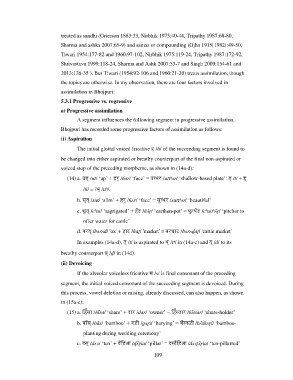
treated as sandhi (Grierson 1883:33, Nirbhik 1975:40-44, Tripathy 1987:68-80,
Sharma and ashka 2007:65-9) and samas or compounding (Ojha 1915[1982]:49-50,
Tiwari 1954:177-82 and 1960:97-102, Nirbhik 1975:119-24, Tripathy 1987:172-92,
Shrivastava 1999:118-24, Sharma and Ashk 2007:53-7 and Singh 2009:154-61 and
2013:126-35 ). But Tiwari (1954:92-106 and 1960:21-30) treats assimilation, though
the topics are otherwise. In my observation, there are four factors involved in
assimilation in Bhojpuri:
5.3.1 Progressive vs. regressive
a) Progressive assimilation
A segment influences the following segment in progressive assimilation.
Bhojpuri has recorded some progressive factors of assimilation as follows:
(i) Aspiration
The initial glottal voiced fricative ह /ɦ/ of the succeeding segment is found to
be changed into either aspirated or breathy counterpart of the final non-aspirated or
voiced stop of the preceding morpheme, as shown in (14a-d):
(14) a. उत् /ut/ up + हर् /ɦʌr/ face = उAथर /uttʰʌr/ shallow-based plate: त् /t/ + N
/ɦ/ = Aथ् /ttʰ/.
b. सुत् /sut/ slim + हर् /ɦʌr/ face = सुAथर /suttʰʌr/ beautiful
c. छुत् /cʰut/ sagrigated + हँड़ /ɦʌɽ/ earthen-pot = छुAथँड़ /cʰuttʰʌɽ/ pitcher to
̃
̃
offer water for cattle
d. बरद् /bʌrʌd/ 'ox' + हाट /ɦɑʈ/ 'market' = बरधाट /bʌrʌd ̤ ɑʈ/ 'cattle market'
In examples (14a-d), त् /t/ is aspirated to थ् /tʰ/ in (14a-c) and द् /d/ to its
breathy counterpart ध् /d ̤ / in (14d).
(ii) Devoicing
If the alveolar voiceless fricative स /s/ is final consonant of the preceding
segment, the initial voiced consonant of the succeeding segment is devoiced. During
this process, vowel deletion or raising, already discussed, can also happen, as shown
in (15a-c):
(15) a. Rहसा /ɦĩsɑ/ share + दार /dɑr/ owner = Rह9तार /ɦĩstɑr/ share-holder
̃
b. बाँस् /bɑs/ bamboo + गड़ी /ɡʌɽi/ burying = बँ9कड़ी /bʌskʌɽi/ bamboo-
̃
planting during wedding ceremony
̃
̃
c. दस् /dʌs/ ten + डँिड़आ /ɖʌɽiɑ/ pillar = द9टँिड़आ /dʌsʈʌɽiɑ/ ten-pillarred
109

