


Page 511 - A GRAMMAR OF BHOJPURI _ PhD Dissertation 2020 TU
P. 511
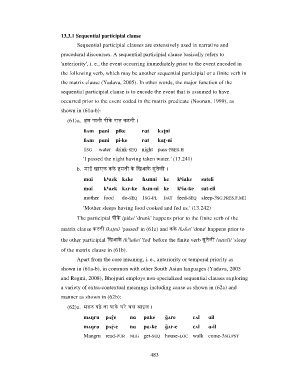
13.3.1 Sequential participial clause
Sequential participial clauses are extensively used in narrative and
procedural discourses. A sequential participial clause basically refers to
'anteriority', i. e., the event occurring immediately prior to the event encoded in
the following verb, which may be another sequential participial or a finite verb in
the matrix clause (Yadava, 2005). In other words, the major function of the
sequential participial clause is to encode the event that is assumed to have
occurred prior to the event coded in the matrix predicate (Noonan, 1999), as
shown in (61a-b):
(61) a. हम पानी पीके रात कटनी ।
ɦʌm pɑni pike rɑt kʌʈni
ɦʌm pɑni pi-ke rɑt kɑʈ-ni
1SG water drink-SEQ night pass-PRES.H
'I passed the night having taken water.' (13.241)
b. माई खाएक कके हमनी के िखआके सुतेली ।
mɑi kʰɑek kʌke ɦʌmni ke kʰiɑke suteli
mɑi kʰɑek kʌr-ke ɦʌm-ni ke kʰiɑ-ke sut-eli
mother food do-SEQ 1SG-PL DAT feed-SEQ sleep-3SG.PRES.F.MH
'Mother sleeps having food cooked and fed us.' (13.242)
The participial पीके /pike/ 'drunk' happens prior to the finite verb of the
matrix clause कटनी /kʌʈni/ 'passed' in (61a) and कके /kʌke/ 'done' happens prior to
the other participial िखआके /kiɑke/ 'fed' before the finite verb सुतेली /suteli/ 'sleep'
of the matrix clause in (61b).
Apart from the core meaning, i. e., anteriority or temporal priority as
shown in (61a-b), in common with other South Asian languages (Yadava, 2005
and Regmi, 2008), Bhojpuri employs non-specialized sequential clauses exploring
a variety of extra-contextual meanings including cause as shown in (62a) and
manner as shown in (62b):
(62) a. मङM पढ़े ना पाके घरे चल आइल ।
mʌŋru pʌɽ ̊ e nɑ pɑke ɡ ̈ ʌre cʌl ɑil
mʌŋru pʌɽ ̊ -e nɑ pɑ-ke ɡ ̈ ʌr-e cʌl ɑ-il
Mangru read-PUR NEG get-SEQ house-LOC walk come-3SG.PST
483

