


Page 513 - A GRAMMAR OF BHOJPURI _ PhD Dissertation 2020 TU
P. 513
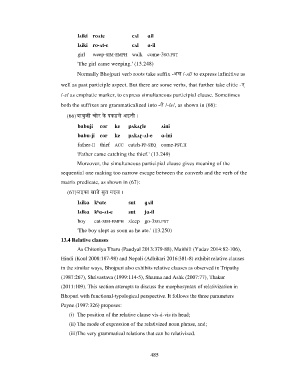
lʌiki  roʌte           cʌl    ɑil
                                 lʌiki  ro-ʌt-e         cʌl    ɑ-il

                                 girl   weep-SIM-EMPH  walk  come-3SG.PST
                                 'The girl came weeping.' (13.248)

                                 Normally Bhojpuri verb roots take suffix -अल /-ʌl/ to express infinitive as

                           well as past participle aspect. But there are some verbs, that further take clitic -ए
                           /-e/ as emphatic marker, to express simultaneous participial clause. Sometimes

                           both the suffixes are grammaticalized into -ले /-le/, as shown in (66):

                             (66) बाबुजी चोर के  पकड़ले अइनी ।
                                 bɑbuji    cor   ke    pʌkʌɽle      ʌini

                                 bɑbu-ji  cor    ke    pʌkʌɽ-ʌl-e   ɑ-ini
                                 father-H  thief  ACC  catch-PP-SEQ  come-PST.H

                                 'Father came catching the thief.' (13.249)
                                 Moreover, the simultaneous participial clause gives meaning of the
                           sequential one making too narrow escape between the converb and the verb of the

                           matrix predicate, as shown in (67):

                             (67) लइका खाते सुत गइल ।
                                 lʌikɑ  kʰɑte          sut   ɡʌil

                                 lʌikɑ  kʰɑ-ʌt-e       sut   jɑ-il
                                 boy    eat-SIM-EMPH  sleep  go-3SG.PST

                                 'The boy slept as soon as he ate.' (13.250)
                           13.4 Relative clauses
                                 As Chitoniya Tharu (Paudyal 2013:379-88), Maithili (Yadav 2014:82-106),

                           Hindi (Koul 2008:187-98) and Nepali (Adhikari 2016:381-8) exhibit relative clauses
                           in the similar ways, Bhojpuri also exhibits relative clauses as observed in Tripathy

                           (1987:267), Shrivastava (1999:114-5), Sharma and Ashk (2007:77), Thakur
                           (2011:109). This section attempts to discuss the morphosyntax of relativization in

                           Bhopuri with functional-typological perspective. It follows the three parameters
                           Payne (1997:326) proposes:

                              (i)  The position of the relative clause vis-à-vis its head;
                              (ii) The mode of expression of the relativized noun phrase, and;
                              (iii)The very grammatical relations that can be relativized.


                                                                485

