


Page 516 - A GRAMMAR OF BHOJPURI _ PhD Dissertation 2020 TU
P. 516
The clause in brackets that is placed after the head noun and has "nominally"
                           modified and restricted the head NP ऊ /u/ 's/he' is a correlative relative clause.

                           b. Internally headed relative clause
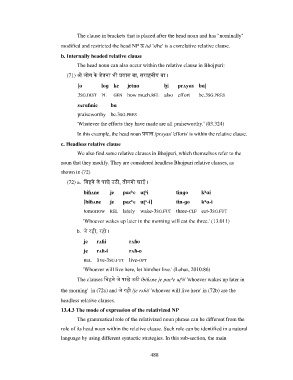
                                 The head noun can also occur within the relative clause in Bhojpuri:

                             (71) ओ लोग के जेतना भी 0यास बा, सराहनीय बा ।

                                 [o        loɡ  ke    jetnɑ           b ̤ i   prʌyɑs  bɑ]
                                 3SG.DIST  PL   GEN  how much.REL  also  effort     be.3SG.PRES

                                 sʌrɑɦnie      bɑ
                                 praiseworthy  be.3SG.PRES

                                 'Whatever the efforts they have made are all praiseworthy.' (03.324)
                                 In this example, the head noun 0यास /prʌyɑs/ 'efforts' is within the relative clause.

                           c. Headless relative clause
                                 We also find some relative clauses in Bhojpuri, which themselves refer to the

                           noun that they modify. They are considered headless Bhojpuri relative clauses, as
                           shown in (72)

                             (72) a.  िबहने जे पाछे उठी, तीनगो खाई ।

                                    biɦʌne     je   pɑcʰe  uʈʰi            tinɡo     kʰɑi
                                    [biɦʌne    je   pɑcʰe  uʈʰ-i]          tin-ɡo    kʰɑ-i
                                    tomorrow  REL  lately  wake-3SG.FUT  three-CLF  eat-3SG.FUT


                                    'Whoever wakes up later in the morning will eat the three.' (13.011)
                                 b.  जे रही, रहो ।
                                    je   rʌɦi          rʌɦo

                                    je   rʌɦ-i         rʌɦ-o
                                    REL  live-3SG.FUT  live-OPT

                                    'Whoever will live here, let him/her live.' (Lohar, 2010:86)
                                 The clauses िबहने जे पाछे उठी /biɦʌne je pɑcʰe uʈʰi/ 'whoever wakes up later in

                           the morning'  in (72a) and जे रही /je rʌɦi/ 'whoever will live here' in (72b) are the

                           headless relative clauses.
                           13.4.3 The mode of expression of the relativized NP

                                 The grammatical role of the relativized noun phrase can be different from the
                           role of its head noun within the relative clause. Such role can be identified in a natural

                           language by using different syntactic strategies. In this sub-section, the main


                                                                488

