


Page 515 - A GRAMMAR OF BHOJPURI _ PhD Dissertation 2020 TU
P. 515
cases the relative clauses modify the head noun, non-finite or participial and finite or
                           correlative relative clauses are nominal modifiers in Bhojpuri.

                           13.4.2 The position of the relative clause vis-à-vis its head
                                 In Bhojpuri, there are three types of relative clauses in terms of their positions
                           with respect to the head noun: externally headed, internally headed and headless.

                           a. Externally headed relative clause
                                 In Bhojpuri, there are two types of externally headed relative clauses: pre-

                           nominal and post-nominal relative clauses.
                           i. Pre-nominal relative clause

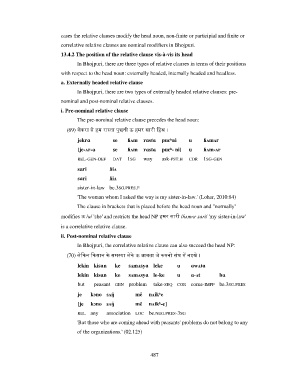
                                 The pre-nominal relative clause precedes the head noun:
                             (69) जेकरा से हम राzता पुछनी ऊ हमर सारी िहअ ।

                                 jekrɑ          se    ɦʌm  rɑstɑ  pucʰni        u     ɦʌmʌr
                                 [je-ʌr-ɑ       se    ɦʌm  rɑstɑ  pucʰ- ni]     u     ɦʌm-ʌr

                                 REL-GEN-DEF    DAT  1SG     way     ask-PST.H   COR  1SG-GEN

                                 sɑri          ɦiʌ
                                 sɑri          ɦiʌ
                                 sister-in-law  be.3SG.PRES.F

                                 'The woman whom I asked the way is my sister-in-law.' (Lohar, 2010:84)
                                 The clause in brackets that is placed before the head noun and "normally"

                           modifies ऊ /u/ 'she' and restricts the head NP हमर सारी /ɦʌmʌr sɑri/ 'my sister-in-law'
                           is a correlative relative clause.

                           ii. Post-nominal relative clause
                                 In Bhojpuri, the correlative relative clause can also succeed the head NP:

                             (70) ले!कन !कसान के समzया लेके ऊ आवता जे कवनो संघ म2 नइखे ।

                                 lekin  kisɑn    ke    sʌmʌsyɑ  leke       u     ɑwʌtɑ
                                 lekin  kisɑn    ke    sʌmʌsyɑ  le-ke      u     ɑ-ʌt        bɑ

                                 but    peasant  GEN  problem    take-SEQ  COR  come-IMPF  be.3SG.PRES

                                 je    kɔno  sʌŋ ̊        mẽ  nʌikʰe
                                 [je   kɔno  sʌŋ ̊        mẽ  nʌikʰ-e]
                                 REL  any     association  LOC  be.NEG.PRES-3SG

                                 'But those who are coming ahead with peasants' problems do not belong to any
                                 of the organizations.' (02.125)


                                                                487

