


Page 510 - A GRAMMAR OF BHOJPURI _ PhD Dissertation 2020 TU
P. 510
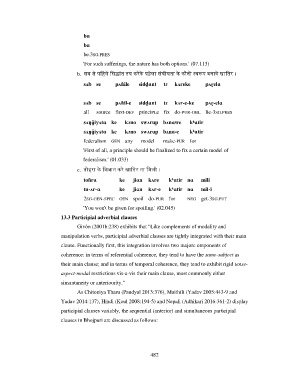
bɑ
bɑ
be.3SG.PRES
'For such sufferings, the nature has both options.' (07.113)
b. सब से पिहले िसांत तय करेके पड़ेला संघीयता के कौनो zवmप बनावे खाितर ।
sʌb se pʌɦile sidd ̤ ɑnt tɛ kʌreke pʌɽelɑ
sʌb se pʌɦil-e sidd̤ ɑnt tɛ kʌr-e-ke pʌɽ-elɑ
all source first-DEF princiPLe fix do-PUR-OBL lie-3SG.PRES
sʌŋɡ ̈ iyʌtɑ ke kɔno swʌrup bʌnɑwe kʰɑtir
sʌŋɡ ̈ iyʌtɑ ke kɔno swʌrup bʌnɑ-e kʰɑtir
federalism GEN any model make-PUR for
'First of all, a principle should be finalized to fix a certain model of
federalism.' (01.033)
c. तोहरा के िजआन करे खाितर ना िमली ।
toɦrɑ ke jiɑn kʌre kʰɑtir nɑ mili
tu-ʌr-ɑ ke jiɑn kʌr-e kʰɑtir nɑ mil-i
2SG-GEN-SPEC GEN spoil do-PUR for NEG get-3SG.FUT
'You won't be given for spoiling.' (02.045)
13.3 Participial adverbial clauses
Givón (2001b:238) exhibits that "Like complements of modality and
manipulation verbs, participial adverbial clauses are tightly integrated with their main
clause. Functionally first, this integration involves two majorc omponents of
coherence: in terms of referential coherence, they tend to have the same-subject as
their main clause; and in terms of temporal coherence, they tend to exhibit rigid tense-
aspect-modal restrictions vis-a-vis their main clause, most commonly either
simuntaneity or anteriourity."
As Chitoniya Tharu (Paudyal 2013:376), Maithili (Yadav 2005:443-9 and
Yadav 2014:137), Hindi (Koul 2008:194-5) and Nepali (Adhikari 2016:361-2) display
participial clauses variably, the sequential (anterior) and simultaneous participial
clauses in Bhojpuri are discussed as follows:
482

