


Page 505 - A GRAMMAR OF BHOJPURI _ PhD Dissertation 2020 TU
P. 505
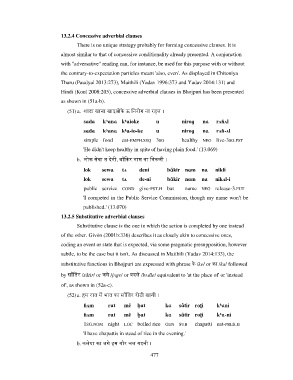
13.2.4 Concessive adverbial clauses
                                 There is no unique strategy probably for forming concessive clauses. It is

                           almost similar to that of concessive conditionality already presented. A conjunction
                           with "adversative" reading can, for instance, be used for this purpose with or without
                           the contrary-to-expectation particles meant 'also, even'. As displayed in Chitoniya

                           Tharu (Paudyal 2013:273), Maithili (Yadav 1996:373 and Yadav 2014:131) and
                           Hindi (Koul 2008:205), concessive adverbial clauses in Bhojpuri has been presented

                           as shown in (51a-b).
                             (51) a.  शादा खाना खाइओके ऊ िनरोग ना रहल ।

                                    sɑdɑ    kʰɑnɑ  kʰɑioke        u          niroɡ    nɑ   rʌɦʌl

                                    sɑdɑ    kʰɑnɑ  kʰɑ-io-ke      u          niroɡ    nɑ   rʌɦ-ʌl
                                    simple  food    eat-EMPH.SEQ  3SG        healthy  NEG  live-3SG.PST
                                    'He didn't keep healthy in spite of having plain food.' (13.069)

                                 b.  लोक सेवा त देनी, बाँ!कर नाम ना िनकली ।

                                    lok     sewɑ    tʌ     deni        bɑ ̃ kir  nɑm  nɑ   nikli
                                    lok     sewɑ    tʌ     de-ni       bɑ ̃ kir  nɑm  nɑ   nikʌl-i

                                    public  service  COND  give-PST.H  but    name  NEG  release-3.FUT
                                    'I competed in the Public Service Commission, though my name won't be

                                    published.' (13.070)
                           13.2.5 Substitutive adverbial clauses
                                 Substitutive clause is the one in which the action is completed by one instead

                           of the other. Givón (2001b:336) describes it as closely akin to concessive ones,
                           coding an event or state that is expected, via some pragmatic presupposition, however

                           subtle, to be the case but it isn't. As discussed in Maithili (Yadav 2014:133), the
                           substitutive functions in Bhojpuri are expressed with phrase के /ke/ or का /kɑ/ followed

                           by साँितर /sɑtir/ or जगे /jʌɡe/ or बदले /bʌdle/ equivalent to 'at the place of' or 'instead
                                      ̃
                           of', as shown in (52a-c).
                             (52) a. हम रात म2 भात का साँितर रोटी खानी ।

                                    ɦʌm       rɑt    mẽ  b ̤ ɑt       kɑ    sɑ ̃ tir  roʈi   kʰɑni

                                    ɦʌm       rɑt    mẽ  b ̤ ɑt       kɑ    sɑ ̃ tir  roʈi   kʰɑ-ni
                                    1SG.NOM  night  LOC  boiled rice  GEN  SUB    chapatti  eat-PRES.H
                                    'I have chapattis in stead of rice in the evening.'

                                 b. कलेया का जगे हम गौर चल गइनी ।

                                                                477

