


Page 509 - A GRAMMAR OF BHOJPURI _ PhD Dissertation 2020 TU
P. 509
13.2.7 Purpose clauses
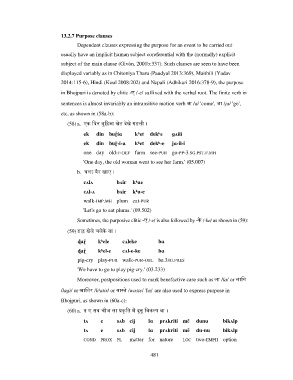
                                 Dependent clauses expressing the purpose for an event to be carried out

                           usually have an implicit human subject coreferential with the (normally) explicit
                           subject of the main clause (Givón, 2001b:337). Such clauses are seen to have been
                           displayed variably as in Chitoniya Tharu (Paudyal 2013:369), Maithili (Yadav

                           2014:115-6), Hindi (Koul 2008:202) and Nepali (Adhikari 2016:378-9), the purpose

                           in Bhojpuri is denoted by clitic -ए /-e/ suffixed with the verbal root. The finite verb in
                           sentences is almost invariably an intransitive motion verb आ /ɑ/ 'come', जा /jɑ/ 'go',

                           etc, as shown in (58a-b):

                             (58) a.  एक !दन बु!ढ़आ खेत देखे गइली ।
                                    ek   din  buɽ ̊ iɑ   kʰet  dekʰe     ɡʌili

                                    ek   din  buɽ ̊ -i-ɑ   kʰet  dekʰ-e   jɑ-il-i
                                    one  day  old-F-DEF  farm  see-PUR  go-PP-3.SG.PST.F.MH

                                    'One day, the old woman went to see her farm.' (05.007)
                                 b.  चलऽ बैर खाए ।

                                    cʌlʌ          bʌir  kʰɑe
                                    cʌl-ʌ         bʌir  kʰɑ-e

                                    walk-IMP.MH  plum  eat-PUR
                                    'Let's go to eat plums.' (09.502)

                                 Sometimes, the purposive clitic -ए /-e/ is also followed by -के /-ke/ as shown in (59):

                             (59) डाढ़ खेले चलेके बा ।
                                 ɖɑɽ ̊    kʰele     cʌleke         bɑ

                                 ɖɑɽ ̊    kʰel-e    cʌl-e-ke       bɑ
                                 pig-cry  play-PUR  walk-PUR-OBL  be.3SG.PRES

                                 'We have to go to play pig-cry.' (03.233)
                                 Moreover, postpositions used to mark benefactive case such as ला /lɑ/ or लािग

                           /lɑɡi/ or खाितर /kʰɑtir/ or वाzते /wɑste/ 'for' are also used to express purpose in

                           Bhojpuri, as shown in (60a-c):
                             (60) a.  त ए सब चीज ला 0कृित म2 दूनू िवकnप बा ।

                                    tʌ     e      sʌb  cij     lɑ  prʌkriti  mẽ  dunu         bikʌlp

                                    tʌ     e      sʌb  cij     lɑ  prʌkriti  mẽ  du-nu        bikʌlp
                                    COND  PROX  PL     matter  for  nature   LOC  two-EMPH  option

                                                                481

