


Page 506 - A GRAMMAR OF BHOJPURI _ PhD Dissertation 2020 TU
P. 506
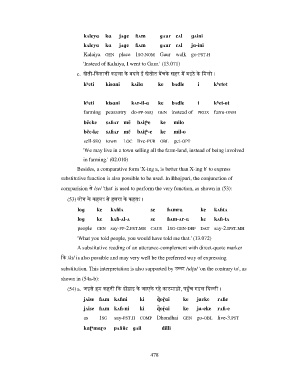
kʌleyɑ  kɑ     jʌɡe  ɦʌm        ɡʌur  cʌl    ɡʌini
                                    kʌleyɑ  kɑ     jʌɡe  ɦʌm        ɡʌur  cʌl    jɑ-ini

                                    Kalaiya  GEN  place  1SG.NOM  Gaur  walk  go-PST.H
                                    'Instead of Kalaiya, I went to Gaur.' (13.071)

                                 c.  खेती-!कसानी कइला के बदले ई खेतोत ब2चके सहर म2 बइठे के िमलो ।
                                    kʰeti    kisɑni     kʌilɑ      ke    bʌdle      i     kʰetot


                                    kʰeti    kisɑni     kʌr-il-ɑ   ke    bʌdle      i     kʰet-ot

                                    farming  peasantry  do-PP-SEQ  GEN  instead of  PROX  farm-ONM

                                    bẽcke    sʌɦʌr  mẽ  bʌiʈʰe      ke    milo
                                    bẽc-ke   sʌɦʌr  mẽ  bʌiʈʰ-e     ke    mil-o
                                    sell-SEQ  town   LOC  live-PUR  OBL  get-OPT

                                    'We may live in a town selling all the farm-land, instead of being involved
                                    in farming.' (02.010)

                                 Besides, a comparative form 'X-ing a, is better than X-ing b' to express
                           substitutive function is also possible to be used. In Bhojpuri, the conjunction of

                           comparision से /se/ 'that' is used to perform the very function, as shown in (53):
                             (53) लोग के कहलऽ से हमरा के कहतऽ ।

                                 loɡ      ke   kʌɦlʌ            se     ɦʌmrɑ         ke    kʌɦtʌ
                                 loɡ      ke   kʌɦ-ʌl-ʌ         se     ɦʌm-ʌr-ɑ      ke    kʌɦ-tʌ

                                 people  GEN  say-PP-2.PST.MH  CAUS  1SG-GEN-DEF  DAT  say-2.IPST.MH

                                 'What you told people, you would have told me that.' (13.072)
                                 A substitutive reading of an utterance-complement with direct-quote marker

                           !क /ki/ is also possible and may very well be the preferred way of expressing

                           substitution. This interpretation is also supported by उnटा /ulʈɑ/ 'on the contrary to', as
                           shown in (54a-b):

                             (54) a.  जइसे हम कहनी !क ढdढ़ाइ के जाएके रहे काठमाड़ो, पUँच गइल !दnली ।
                                                                   ̈
                                    jʌise  ɦʌm  kʌɦni      ki      ɖoɽ ̊ ɑi   ke   jɑeke    rʌɦe
                                                                   ̈
                                    jʌise  ɦʌm  kʌɦ-ni     ki      ɖoɽ ̊ ɑi   ke   jɑ-eke  rʌɦ-e
                                    as    1SG    say-PST.H  COMP  Dhondhai  GEN  go-OBL  live-3.PST

                                    kɑʈʰmɑɽo     pʌɦũc  ɡʌil         dilli


                                                                478

