


Page 501 - A GRAMMAR OF BHOJPURI _ PhD Dissertation 2020 TU
P. 501
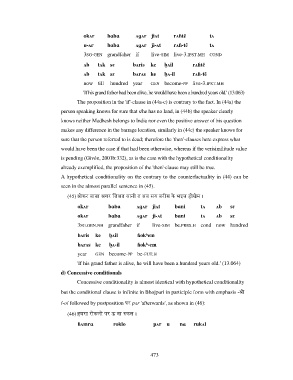
okʌr      bɑbɑ        ʌɡʌr  jiʌt      rʌɦtẽ          tʌ
                                    u-ʌr      bɑbɑ        ʌɡʌr  ji-ʌt     rʌɦ-tẽ         tʌ

                                    3SG-GEN  grandfaher  if     live-SIM  live-3.IPST.MH  COND

                                    ʌb    tʌk  sɛ        bʌris  ke    b ̤ ʌil     rʌɦtẽ
                                    ʌb    tʌk  sɛ        bʌrʌs  ke    b̤ ʌ-il     rʌɦ-tẽ
                                    now  till  hundred  year    GEN  become-PP  live-3.IPST.MH

                                    'If his grand father had been alive, he would have been a hundred years old.' (13.063)
                                 The proposition in the 'if'-clause in (44a-c) is contrary to the fact. In (44a) the
                           person speaking knows for sure that s/he has no land, in (44b) the speaker clearly

                           knows neither Madhesh belongs to India nor even the positive answer of his question
                           makes any difference in the barrage location, similarly in (44c) the speaker knows for

                           sure that the person referred to is dead; therefore the 'then'-clauses here express what
                           would have been the case if that had been otherwise, whereas if the verisimilitude value

                           is pending (Givón, 2001b:332), as is the case with the hypothetical conditionality
                           already exemplified, the proposition of the 'then'-clause may still be true.

                           A hypothetical conditionality on the contrary to the counterfactuality in (44) can be
                           seen in the almost parallel sentence in (45).

                             (45) ओकर बाबा अगर िजअत बानी त अब सय बरीस के भइल होखेम ।
                                 okʌr         bɑbɑ        ʌɡʌr  jiʌt      bɑni       tʌ    ʌb    sɛ

                                 okʌr         bɑbɑ        ʌɡʌr  ji-ʌt     bɑni       tʌ    ʌb    sɛ
                                 3SG.GEN.NH  grandfaher  if      live-SIM  be.PRES.H  cond  now  hundred

                                 bʌris  ke     b ̤ ʌil    ɦokʰem
                                 bʌrʌs  ke     b ̤ ʌ-il   ɦokʰ-em

                                 year    GEN  become-PP  be-FUT.H
                                 'If his grand father is alive, he will have been a hundred years old.' (13.064)
                           d) Concessive conditionals

                                 Concessive conditionality is almost identical with hypothetical conditionality
                           but the conditional clause is infinite in Bhojpuri in participle form with emphasis -ओ

                           /-o/ followed by postposition पर pʌr 'afterwards', as shown in (46):

                             (46) हमरा रोकलो पर ऊ ना Mकल ।

                                 ɦʌmrɑ          roklo            pʌr  u     nɑ    rukʌl


                                                                473

