


Page 497 - A GRAMMAR OF BHOJPURI _ PhD Dissertation 2020 TU
P. 497
i) Intermediacy
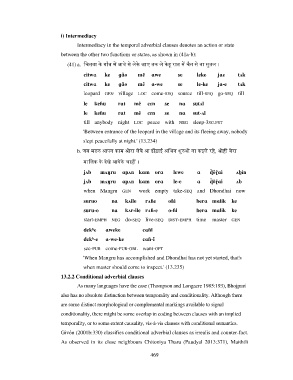
                                 Intermediacy in the temporal adverbial clauses denotes an action or state

                           between the other two functions or states, as shown in (41a-b):
                             (41) a.  िचतवा के गाँव म2 आवे से लेके जाए तक ले केi रात म2 चैन से ना सुतल ।

                                    citwɑ    ke    ɡɑ ̃ o   mẽ  ɑwe        se      leke     jɑe     tʌk
                                    citwɑ    ke    ɡɑ ̃ o   mẽ  ɑ-we       se      le-ke    jɑ-e    tʌk

                                    leopard  GEN  village  LOC  come-SEQ  source  till-SEQ  go-SEQ  till

                                    le   keɦu     rɑt    mẽ  cɛn      se    nɑ    sutʌl
                                    le   keɦu     rɑt    mẽ  cɛn      se    nɑ    sut-ʌl
                                    till  anybody  night  LOC  peace  with  NEG  sleep-3SG.PST

                                    'Between entrance of the leopard in the village and its fleeing away, nobody
                                    slept peacefully at night.' (13.234)
                                 b. जब मङM आपन काम ओरा लेवे आ ढdढ़ाई अिभन शुMओ ना कइले रहे, ओही बेरा


                                    मािलक के देखे आवेके चाहO ।
                                                                                         ̈
                                    jʌb    mʌŋru  ɑpʌn  kɑm  orɑ         lewe      ɑ     ɖõɽ ̊ ɑi   ʌb ̤ in
                                                                                         ̈
                                    jʌb    mʌŋru  ɑpʌn  kɑm  orɑ         le-e      ɑ     ɖõɽ ̊ ɑi   ʌb
                                    when  Mangru  GEN      work  empty  take-SEQ  and  Dhondhai  now

                                    suruo       nɑ   kʌile    rʌɦe     oɦi         berɑ  mɑlik  ke
                                    suru-o      nɑ   kʌr-ile  rʌɦ-e    o-ɦi        berɑ  mɑlik  ke

                                    start-EMPH  NEG  do-SEQ  live-SEQ  DIST-EMPH  time  master  GEN

                                    dekʰe    ɑweke           cɑɦĩ
                                    dekʰ-e   ɑ-we-ke         cɑɦ-ĩ
                                    see-PUR  come-PUR-OBL  want-OPT

                                    'When Mangru has accomplished and Dhondhai has not yet started, that's
                                    when master should come to inspect.' (13.235)

                           13.2.2 Conditional adverbial clauses
                                 As many languages have the case (Thompson and Longacre 1985:193), Bhojpuri
                           also has no absolute distinction between temporality and conditionality. Although there

                           are some distinct morphological or complemental markings available to signal
                           conditionality, there might be some overlap in coding between clauses with an implied

                           temporality, or to some extent causality, vis-à-vis clauses with conditional semantics.
                           Givón (2001b:330) classifies conditional adverbial clauses as irrealis and counter-fact.
                           As  observed  in  its  close  neighbours  Chitoniya  Tharu  (Paudyal  2013:371),  Maithili


                                                                469

