


Page 493 - A GRAMMAR OF BHOJPURI _ PhD Dissertation 2020 TU
P. 493
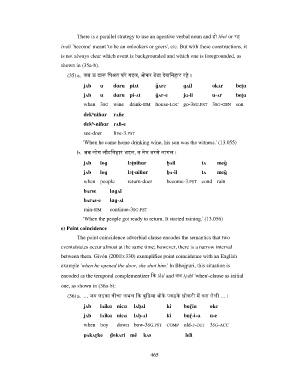
There is a parallel strategy to use an agentive verbal noun and हो /ɦo/ or रह

                           /rʌɦ/ 'become' meant 'to be an onlookers or goers', etc. But with these constructions, it
                           is not always clear which event is backgrounded and which one is foregrounded, as
                           shown in (35a-b).

                             (35) a.  जब ऊ दाm िपअत घरे गइल, ओकर बेटा देखिनहार रहे ।

                                    jʌb    u    dɑru  piʌt        ɡ ̈ ʌre     ɡʌil        okʌr      beʈɑ
                                    jʌb    u    dɑru  pi-ʌt       ɡ ̈ ʌr-e    jɑ-il       u-ʌr      beʈɑ

                                    when  3SG  wine  drink-SIM  house-LOC  go-3SG.PST  3SG-GEN  son

                                    dekʰniɦɑr  rʌɦe
                                    dekʰ-niɦɑr  rʌɦ-e
                                    see-doer    live-3.PST

                                    'When he came home drinking wine, his son was the witness.' (13.055)
                                 b.  जब लोग लौटिनहार भइल, त मेघ बरसे लागल ।

                                    jʌb    loɡ        lɔʈniɦɑr         b ̤ ʌil       tʌ     meɡ ̈
                                    jʌb    loɡ        lɔʈ-niɦɑr        b ̤ ʌ-il      tʌ     meɡ ̈

                                    when  people      return-doer      become-3.PST  cond  rain
                                    bʌrse      lɑɡʌl

                                    bʌrʌs-e    lɑɡ-ʌl
                                    rain-SIM   continue-3SG.PST
                                    'When the people got ready to return, It started raining.' (13.056)

                           e) Point coincidence
                                 The point coincidence adverbial clause encodes the semantics that two

                           events/states occur almost at the same time; however, there is a narrow interval
                           between them. Givόn (2001b:330) exemplifies point coincidence with an English

                           example 'when he opened the door, she shot him.' In Bhojpuri, this situation is
                           encoded as the temporal complementizer !क /ki/ and जब /jʌb/ 'when'-clause as initial

                           one, as shown in (36a-b):

                             (36) a.  ... जब लइका नीचा लभल !क बु!ढ़आ ओके पकड़के धोकरी म2 कस लेली ... ।
                                    jʌb    lʌikɑ  nicɑ   lʌb ̤ ʌl      ki     buɽ ̊ iɑ   oke

                                    jʌb    lʌikɑ  nicɑ   lʌb ̤ -ʌl     ki     buɽ ̊ -i-ɑ   u-e
                                    when  boy     down  bow-3SG.PST  COMP  old-F-DET  3SG-ACC

                                    pʌkʌɽke    d ̤ okʌri  mẽ  kʌs             leli


                                                                465

