


Page 498 - A GRAMMAR OF BHOJPURI _ PhD Dissertation 2020 TU
P. 498
(Yadav 1996:369), Hindi (Koul 2008:256) and Nepali (Adhikari 2016:372), Bhojpuri
                           has  the  conditional  adverbial  clauses  as  also  displayed  in  Tiwari  (1960:175  and

                           1984:512), Nirbhik (1975:94), Sharma and Ashk (2007:41), Thakur (2011:105) and
                           Singh (2013:97). In this study they are discussed as follows:

                           a) Irrealis conditionals
                                 Irrealis conditional clauses do not have truth values, so, they fall under the
                           scope of non-fact modality. Besides, their truth value relies upon the truth value of

                           their associated main clause that itself is also under irrealis scope and thus has no
                           truth value either.

                                 Typically, irrealis conditionals have an implied futurity, with the main clause
                           itself marked by either future, modal or some other irrealis operator (Givón,

                           2001b:331). In Bhojpuri, the main clause and the irrealis conditional are both in
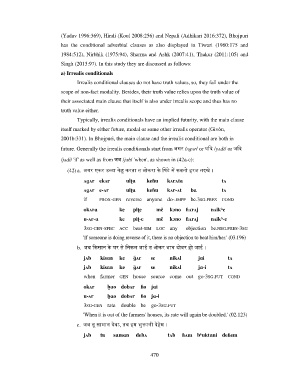
                           future. Generally the irrealis conditionals start from अगर /ʌɡʌr/ or य!द /yʌdi/ or ज!द

                           /jʌdi/ 'if' as well as from जब /jʌb/ 'when', as shown in (42a-c):

                             (42) a.  अगर एकर उnटा केi करता त ओकरा के िपटे म2 कवनो हरज नइखे ।

                                    ʌɡʌr  ekʌr        ulʈɑ    keɦu     kʌrʌtɑ                 tʌ
                                    ʌɡʌr  e-ʌr        ulʈɑ    keɦu     kʌr-ʌt    bɑ           tʌ
                                    if     PROX-GEN  reverse  anyone  do-.IMPF  be.3SG.PRES  COND


                                    okʌrɑ          ke    piʈe     mẽ  kɔno  ɦʌrʌj        nʌikʰe
                                    u-ʌr-ɑ         ke    piʈ-e    mẽ  kɔno  ɦʌrʌj        nʌikʰ-e

                                    3SG-GEN-SPEC  ACC  beat-SIM  LOC  any      objection  be.NEG.PRES-3SG
                                    'If someone is doing reverse of it, there is no objection to beat him/her.' (03.196)

                                 b.  जब !कसान के घर से िनकल जाई त ओकर भाव दोबर हो जाई ।

                                    jʌb    kisɑn  ke     ɡ ̈ ʌr   se    nikʌl       jɑi         tʌ
                                    jʌb    kisɑn  ke     ɡ ̈ ʌr   se    nikʌl       jɑ-i        tʌ

                                    when  farmer  GEN  house  source  come  out  go-3SG.FUT  COND

                                    okʌr      b ̤ ɑo  dobʌr  ɦo  jɑi
                                    u-ʌr      b ̤ ɑo  dobʌr  ɦo  jɑ-i
                                    3SG-GEN  rate  double  be  go-3SG.FUT

                                    'When it is out of the farmers' houses, its rate will again be doubled.' (02.123)
                                 c.  जब तू सामान देबऽ, तब हम भुvानी देहेम ।

                                    jʌb    tu   sɑmɑn     debʌ         tʌb  ɦʌm  bʰuktɑni  deɦem


                                                                470

