


Page 517 - A GRAMMAR OF BHOJPURI _ PhD Dissertation 2020 TU
P. 517
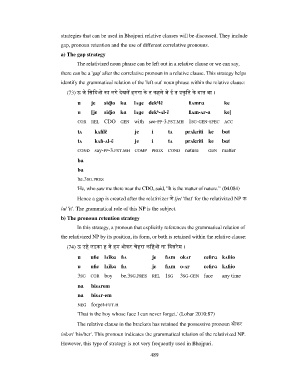
strategies that can be used in Bhojpuri relative clauses will be discussed. They include
                           gap, pronoun retention and the use of different correlative pronouns.

                           a) The gap strategy
                                 The relativized noun phrase can be left out in a relative clause or we can say,
                           there can be a 'gap' after the correlative pronoun in a relative clause. This strategy helps

                           identify the grammatical relation of the 'left out' noun phrase within the relative clause:

                             (73) ऊ जे िसिडओ का लगे देखल2 हमरा के त कहले जे ई त 0कृित के बात बा ।
                                 u     je    siɖio  kɑ   lʌɡe  dekʰlẽ           ɦʌmrɑ          ke

                                 u     [je   siɖio  kɑ   lʌɡe  dekʰ-ʌl-ẽ        ɦʌm-ʌr-ɑ       ke]
                                 COR  REL  CDO  GEN  with  see-PP-3.PST.MH  1SG-GEN-SPEC  ACC

                                 tʌ      kʌɦlẽ           je     i      tʌ     prʌkriti  ke    bɑt
                                 tʌ      kʌɦ-ʌl-ẽ        je     i      tʌ     prʌkriti  ke    bɑt

                                 COND  say-PP-3.PST.MH  COMP  PROX  COND  nature        GEN  matter

                                 bɑ
                                 bɑ
                                 be.3SG.PRES

                                 'He, who saw me there near the CDO, said, "It is the matter of nature."' (04.084)
                                 Hence a gap is created after the relativizer जे /je/ 'that' for the relativized NP ऊ

                           /u/ 'it'. The grammatical role of this NP is the subject.
                           b) The pronoun retention strategy

                                 In this strategy, a pronoun that explicitly references the grammatical relation of
                           the relativized NP by its position, its form, or both is retained within the relative clause:

                             (74) ऊ उहे लइका ह जे हम ओकर चेहरा किहओ ना िबसरेम ।
                                 u     uɦe  lʌikɑ  ɦʌ            je   ɦʌm  okʌr       ceɦrɑ  kʌɦio

                                 u     uɦe  lʌikɑ  ɦʌ            je   ɦʌm  o-ʌr       ceɦrɑ  kʌɦio
                                 3SG  COR  boy      be.3SG.PRES  REL  1SG   3SG-GEN  face     any time


                                 nɑ    bisʌrem
                                 nɑ    bisʌr-em

                                 NEG  forget-FUT.H
                                 'That is the boy whose face I can never forget.' (Lohar 2010:87)

                                 The relative clause in the brackets has retained the possessive pronoun ओकर
                           /okʌr/ 'his/her'. This pronoun indicates the grammatical relation of the relativized NP.

                           However, this type of strategy is not very frequently used in Bhojpuri.

                                                                489

