


Page 522 - A GRAMMAR OF BHOJPURI _ PhD Dissertation 2020 TU
P. 522
'Where there is life, there is death. (09.510)
                                             ̃
                                 The NP /jʌɦɑ jiʌn/ 'where there is life' is in the locative case and is relativized.
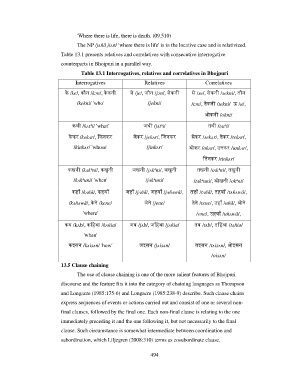
                           Table 13.1 presents relatives and correlatives with consecutive interrogative
                           counterparts in Bhojpuri in a parallel way.

                                   Table 13.1 Interrogatives, relatives and correlatives in Bhojpuri
                                 Interrogatives              Relatives                 Correlatives
                            के /ke/, कौन /kɔn/, केकनी   जे /je/, जौन /jɔn/, जेकनी   से /se/, सेकनी /sekni/, तौन

                                 /kekni/ 'who'                 /jekni/           /tɔn/, तेकनी /tekni/  ऊ /u/,

                                                                                       ओकनी /okni/

                               कथी /kʌtʰi/ 'what'            जथी /jʌtʰi/                तथी /tʌtʰi/

                              केकर /kekʌr/, !कनकर        जेकर /jekʌr/, िजनकर     सेकर /sekʌr/, तेकर /tekʌr/,

                                /kinkʌr/ 'whose'              /jinkʌr/          ओकर /okʌr/, उनकर /unkʌr/,

                                                                                      ितनकर /tinkʌr/
                             कखनी /kʌkʰni/, कखुनी       जखनी /jʌkʰni/, जखुनी       तखनी /tʌkʰni/, तखुनी

                                /kʌkʰuni/ 'when'              /jʌkʰuni/           /tʌkʰuni/, ओखनी /okʰni/

                               कहाँ /kʌɦɑ/, कहवाँ     जहाँ /jʌɦɑ/, जहवाँ /jʌɦʌwɑ/,   तहाँ /tʌɦɑ/, तहवाँ /tʌɦʌwɑ/,
                                                              ̃
                                                                            ̃
                                                                                         ̃
                                                                                                       ̃
                                        ̃
                                     ̃
                              /kʌɦʌwɑ/, केने /kene/          जेने /jene/         तेने /tene/, उहाँ /uɦɑ/, ओने
                                                                                                  ̃
                                    'where'                                        /one/, उहवाँ /uɦʌwɑ/,
                                                                                                    ̃
                            कब /kʌb/, किहआ /kʌɦiɑ/     जब /jʌb/, जिहआ /jʌɦiɑ/     तब /tʌb/, तिहआ /tʌɦiɑ/
                                    'when'
                              कइसन /kʌisʌn/ 'how'          जइसन /jʌisʌn/           तइसन /tʌisʌn/, ओइसन

                                                                                         /oisʌn/

                           13.5 Clause chaining
                                 The use of clause chaining is one of the more salient features of Bhojpuri
                           discourse and the feature fits it into the category of chaining languages as Thompson

                           and Longacre (1985:175-6) and Longacre (1985:238-9) describe. Such clause chains
                           express sequences of events or actions carried out and consist of one or several non-

                           final clauses, followed by the final one. Each non-final clause is relating to the one
                           immediately preceding it and the one following it, but not necessarily to the final

                           clause. Such circumstance is somewhat intermediate between coordination and
                           subordination, which Liljegren (2008:310) terms as cosubordinate clause.


                                                                494

