


Page 467 - A GRAMMAR OF BHOJPURI _ PhD Dissertation 2020 TU
P. 467
way in those days."' (02.050)
c. ए पर बिल त थोड़ा-सा हँसल2 भी !क आरे दFरG HाIण तोरा भीखमङे रहेके बा सारा
िजनगी ?
e pʌr bʌli tʌ tʰoɽɑ sɑ ɦʌ ̃ slẽ b ̤ i ki
e pʌr bʌli tʌ tʰoɽɑ sɑ ɦʌ ̃ s-ʌl-ẽ b ̤ i ki
PROX LOC Bali COND little as laugh-PP-3.PST.MH also COMP
ɑre dʌridrʌ brɑɦmʌn torɑ b ̤ ikʰmʌŋe rʌɦeke
ɑre dʌridrʌ brɑɦmʌn torɑ b ̤ ikʰmɑŋɑ-e rʌɦ-e-ke
VOC poor Brahmin 2SG.GEN beggar-EMPH live-PUR-OBL
bɑ sɑrɑ jinɡi
bɑ sɑrɑ jinɡi
be.3SG.PRES whole life
'Bali laughed shortly at him and said, "O poor Brahmin! Do you want to
remain a lifelong beggar?"' (07.042)
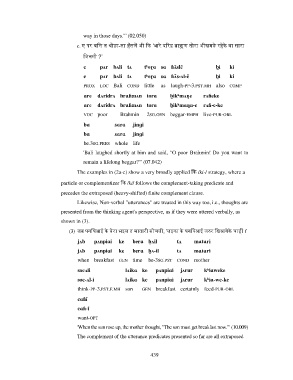
The examples in (2a-c) show a very broadly applied !क /ki-/ strategy, where a
particle or complementizer !क /ki/ follows the complement-taking predicate and
precedes the extraposed (heavy-shifted) finite complement clause.
Likewise, Non-verbal "utterances" are treated in this way too, i.e., thoughts are
presented from the thinking agent's perspective, as if they were uttered verbally, as
shown in (3).
(3) जब पनिपआई के बेरा भइल त मातारी सोचली, लइका के पनिपआई जMर िखआवेके चाहO ।
jʌb pʌnpiɑi ke berɑ b ̤ ʌil tʌ mɑtɑri
jʌb pʌnpiɑi ke berɑ b ̤ ʌ-il tʌ mɑtɑri
when breakfast GEN time be-3SG.PST COND mother
socʌli lʌikɑ ke pʌnpiɑi jʌrur kʰiɑweke
soc-ʌl-i lʌikɑ ke pʌnpiɑi jʌrur kʰiɑ-we-ke
think-PP-3.PST.F.MH son GEN breakfast certainly feed-PUR-OBL
cɑɦĩ
cɑɦ-ĩ
want-OPT
'When the sun rose up, the mother thought, "The son must get breakfast now."' (10.009)
The complement of the utterance predicates presented so far are all extraposed
439

