


Page 471 - A GRAMMAR OF BHOJPURI _ PhD Dissertation 2020 TU
P. 471
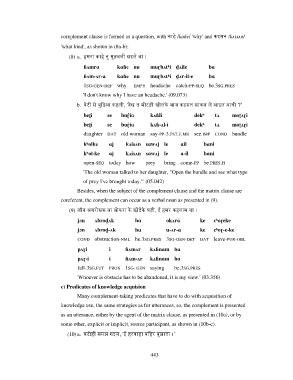
complement clause is formed as a question, with काहे /kɑɦe/ 'why' and कइसन /kʌisʌn/
'what kind', as shown in (8a-b):
(8) a. हमरा काहे नु मुड़बथी धइले बा ।
ɦʌmrɑ kɑɦe nu muɽbʌtʰi d ̤ ʌile bɑ
ɦʌm-ʌr-ɑ kɑɦe nu muɽbʌtʰi d ̤ ʌr-il-e bɑ
1SG-GEN-DEF why EMPH headache catch-PP-SEQ be.3SG.PRES
'I don't know why I have an headache.' (09.073)
b. बेटी से बु!ढ़आ कहली, देख त मोटड़ी खोलके आज कइसन सावज ले आइल बानी ?
beʈi se buɽ ̊ iɑ kʌɦli dekʰ tʌ moʈʌɽi
beʈi se buɽ ̊ iɑ kʌɦ-ʌl-i dekʰ tʌ moʈʌɽi
daughter DAT old woman say-PP-3.PST.F.MH see.IMP COND bundle
kʰolke ɑj kʌisʌn sɑwʌj le ɑil bɑni
kʰol-ke ɑj kʌisʌn sɑwʌj le ɑ-il bɑni
open-SEQ today how prey bring come-PP be.PRES.H
'The old woman talked to her daughter, "Open the bundle and see what type
of prey I've brought today."' (05.042)
Besides, when the subject of the complement clause and the matrix clause are
coreferent, the complement can occur as a verbal noun as presented in (9).
(9) जौन अवरोधक बा ओकरा के छोड़ेके पड़ी, ई हमर कहनाम बा ।
jɔn ʌbrod ̤ ʌk bɑ okʌrɑ ke cʰoɽeke
jɔn ʌbrod ̤ -ʌk bɑ u-ʌr-ɑ ke cʰoɽ-e-ke
COND obstruction-NML be.3SG.PRES 3SG-GEN-DET DAT leave-PUR-OBL
pʌɽi i ɦʌmʌr kʌɦnɑm bɑ
pʌɽ-i i ɦʌm-ʌr kʌɦnɑm bɑ
fall-3SG.FUT PROX 1SG- GEN saying be.3SG.PRES
'Whoever is obstacle has to be abandoned, it is my view.' (03.356)
c) Predicates of knowledge acquision
Many complement-taking predicates that have to do with acquisition of
knowledge use, the same strategies as for utterances, so, the complement is presented
as an utterance, either by the agent of the matrix clause, as presented in (10a), or by
some other, explicit or implicit, source participant, as shown in (10b-c).
(10) a. बटोही समझ गइल, ई हरवाहा बिहर बुझाता ।
443

