


Page 474 - A GRAMMAR OF BHOJPURI _ PhD Dissertation 2020 TU
P. 474
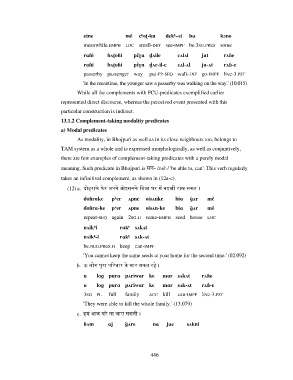
etne             mẽ  cʰoʈ-ku      dekʰ-ʌt   bɑ           kɔno
                                    meanwhile.EMPH  LOC  small-DET  see-IMPF  be.3SG.PRES  some

                                    rɑɦi      bʌʈoɦi     pɛ ̃ ɽɑ  d ̤ ʌile   cʌlʌl   jɑt       rʌɦe
                                    rɑɦi      bʌʈoɦi     pɛ ̃ ɽɑ  d ̤ ʌr-il-e   cʌl-ʌl   jɑ-ʌt   rʌɦ-e

                                    passerby  passenger  way  put-PP-SEQ  walk-INF  go-IMPF  live-3.PST
                                    'In the meantime, the younger saw a passerby was walking on the way.' (10.015)

                                 While all the complements with PCU-predicates exemplified earlier
                           represented direct discourse, whereas the perceived event presented with this
                           particular construction is indirect.

                           13.1.2 Complement-taking modality predicates
                           a) Modal predicates

                                 As modality, in Bhojpuri as well as in its close neighbours too, belongs to
                           TAM system as a whole and is expressed morphologically, as well as conjuntively,

                           there are few examples of complement-taking predicates with a purely modal
                           meaning. Such predicate in Bhojpuri is सक- /sʌk-/ 'be able to, can'. This verb regularly

                           takes an infinitival complement, as shown in (12a-c).

                             (12) a.  दोहराके फे र अपने ओइसनके िबआ घर म2 नइखO राख सकत ।
                                    doɦrɑke     pʰer   ʌpne  oisʌnke      biɑ   ɡ ̈ ʌr   mẽ

                                    doɦrɑ-ke  pʰer     ʌpne  oisʌn-ke     biɑ   ɡ ̈ ʌr   mẽ
                                    repeat-SEQ  again  2SG.H  same-EMPH  seed  house  LOC

                                    nʌikʰĩ         rɑkʰ  sʌkʌt
                                    nʌikʰ-ĩ        rɑkʰ  sʌk-ʌt

                                    be.NEG.PRES.H  keep  can-IMPF
                                    'You cannot keep the same seeds at your home for the second time.' (02.092)

                                 b.  ऊ लोग पूरा पFरवार के मार सकत रहे ।
                                    u    loɡ  purɑ  pʌriwɑr  ke      mɑr  sʌkʌt      rʌɦe

                                    u    loɡ  purɑ  pʌriwɑr  ke      mɑr  sʌk-ʌt     rʌɦ-e
                                    3SG  PL   full   family    ACC  kill   can-IMPF  live-3.PST

                                    'They were able to kill the whole family.' (13.079)
                                 c.  हम आज घरे ना जाए सकनी ।

                                    ɦʌm       ɑj     ɡ ̈ ʌre     nɑ    jɑe     sʌkni


                                                                446

