


Page 465 - A GRAMMAR OF BHOJPURI _ PhD Dissertation 2020 TU
P. 465
CHAPTER 13
INTER-CLAUSAL COHERENCE
13.0 Outline
This chapter deals with inter-clausal coherence in Bhojpuri. It consists of
seven sections. Section 13.1 deals with verbal complements, and subordinate
adverbial clauses are explained in section 13.2. Likewise, we describe participial
adverbial clauses in section 13.3 and relative clauses in section 13.4. Clause chaining
is discussed in section 13.5 and conjoined clauses are discussed in section 13.6.
Finally, we summarize the chapter in section 13.7.
13.1 Complement clauses
Different strategies are utilized in Bhojpuri for sentential complementation,
mainly determined by complement-taking verb. Besides, due to the degree of
semantic bond between the complement-taking predicate and the verbal element of
the complement (Givón, 2001b:39), most of them fall, quite clearly, into one of the
two main types: (a) finite complements, and (b) non-finite complements, as attested in
Chitoniya Tharu (Paudyal 2013:355), Maithili (Yadav 1996:348 and Yadav 2014:48),
Hindi (Koul 2008:181) and Nepali (Adhikari 2016:370-2). Bhojpuri also observes the
same (Thakur 2011:136). Hence the complements of the first type are simply
extraposed and syntactically relatively independent from the main clause and the
complements of the second type are almost invariably embedded into the main clause
and have a time reference entirely determined by the main clause.
13.1.1 Complement-taking PCU predicates
In Bhojpuri, कह /kʌɦ/ 'say, tell' is the verb that takes PCU predicates, as shown
in (1a-b).
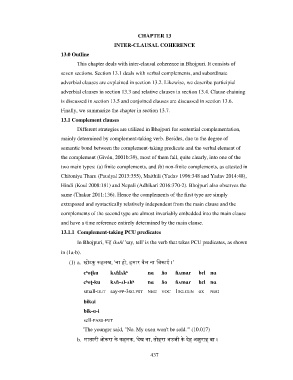
(1) a. छोटकु कहलख, ना हो, हमार बैल ना िबकाई ।
cʰoʈku kʌɦlʌkʰ nɑ ɦo ɦʌmɑr bɛl nɑ
cʰoʈ-ku kʌɦ-ʌl-ʌkʰ nɑ ɦo ɦʌmɑr bɛl nɑ
small-DET say-PP-3SG.PST NEG VOC 1SG.GEN ox NEG
bikɑi
bik-ɑ-i
sell-PASS-FUT
'The younger said, "No. My oxen won't be sold."' (10.017)
b. मातारी ओकरा के कहलक, देख ना, तोहरा भउजी के देह अझुराह बा ।
437

