


Page 462 - A GRAMMAR OF BHOJPURI _ PhD Dissertation 2020 TU
P. 462
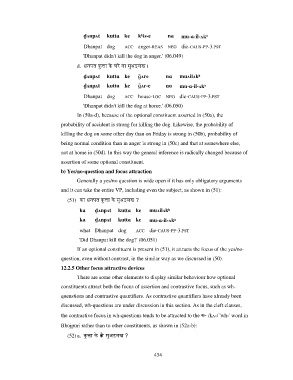
d ̤ ʌnpʌt kuttɑ ke kʰis-e nɑ mu -ɑ-il-ʌkʰ
Dhanpat dog ACC anger-REAS NEG die-CAUS-PP-3.PST
'Dhanpat didn't kill the dog in anger.' (06.049)
d. धनपत कुा के घरे ना मुअइलख ।
d ̤ ʌnpʌt kuttɑ ke ɡ ̈ ʌre nɑ muʌilʌkʰ
d ̤ ʌnpʌt kuttɑ ke ɡ ̈ ʌr-e nɑ mu -ɑ-il-ʌkʰ
Dhanpat dog ACC house-LOC NEG die-CAUS-PP-3.PST
'Dhanpat didn't kill the dog at home.' (06.050)
In (50a-d), because of the optional constituent asserted in (50a), the
probability of accident is strong for killing the dog. Likewise, the probability of
killing the dog on some other day than on Friday is strong in (50b), probability of
being normal condition than in anger is strong in (50c) and that at somewhere else,
not at home in (50d). In this way the general inference is radically changed because of
assertion of some optional constituent.
b) Yes/no-question and focus attraction
Generally a yes/no question is wide open if it has only obligatory arguments
and it can take the entire VP, including even the subject, as shown in (51):
(51) का धनपत कुा के मुअइलख ?
kɑ d ̤ ʌnpʌt kuttɑ ke muʌilʌkʰ
kɑ d ̤ ʌnpʌt kuttɑ ke mu -ɑ-il-ʌkʰ
what Dhanpat dog ACC die-CAUS-PP-3.PST
'Did Dhanpat kill the dog?' (06.051)
If an optional constituent is present in (51), it attracts the focus of the yes/no-
question, even without contrast, in the similar way as we discussed in (50).
12.2.5 Other focus attractive devices
There are some other elements to display similar behaviour how optional
constituents attract both the focus of assertion and contrastive focus, such as wh-
quenstions and contrastive quantifiers. As contrastive quantifiers have already been
discussed, wh-questions are under discussion in this section. As in the cleft clauses,
the contrastive focus in wh-questions tends to be attracted to the क- /kʌ-/ 'wh-' word in
Bhojpuri rather than to other constituents, as shown in (52a-b):
(52) a. कुा के के मुअइलख ?
434

