


Page 385 - A GRAMMAR OF BHOJPURI _ PhD Dissertation 2020 TU
P. 385
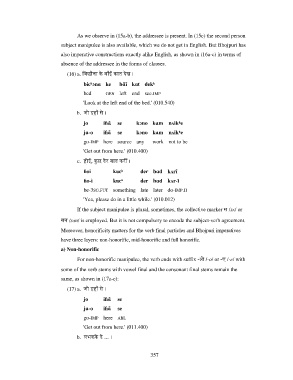
As we observe in (15a-b), the addressee is present. In (15c) the second person
                           subject manipulee is also available, which we do not get in English. But Bhojpuri has

                           also imperative constructions exactly alike English, as shown in (16a-c) in terms of
                           absence of the addressee in the forms of clauses.

                             (16) a. िबछौना के बाँG कात देख ।
                                    bicʰɔnɑ  ke    bɑ ̃ ĩ  kɑt  dekʰ

                                    bed      GEN  left  end  see.IMP
                                    'Look at the left end of the bed.' (010.540)

                                 b.  जो इहाँ से ।

                                    jo      iɦɑ ̃   se    kɔno  kɑm  nʌikʰe
                                    jɑ-o    iɦɑ ̃   se    kɔno  kɑm  nʌikʰe
                                    go-IMP  here  source  any    work  not to be

                                    'Get out from here.' (010.400)

                                 c.  होई, कुछ देर बाद कर3 ।
                                    ɦoi         kucʰ        der  bɑd  kʌrĩ

                                    ɦo-i        kucʰ        der  bɑd  kʌr-ĩ
                                    be-3SG.FUT  something  late  later  do-IMP.H
                                    'Yea, please do in a little while.' (010.012)

                                 If the subject manipulee is plural, sometimes, the collective marker स /sʌ/ or

                           सन /sʌn/ is employed. But it is not compulsory to encode the subject-verb agreement.

                           Moreover, honorificity matters for the verb final particles and Bhojpuri imperatives
                           have three layers: non-honorific, mid-honorific and full honorific.
                           a) Non-honorific

                                 For non-honorific manipulee, the verb ends with suffix -ओ /-o/ or -ए /-e/ with

                           some of the verb stems with vowel final and the consonant final stems remain the
                           same, as shown in (17a-c):

                             (17) a.  जो इहाँ से ।
                                    jo      iɦɑ ̃   se

                                    jɑ-o    iɦɑ ̃   se
                                    go-IMP  here  ABL

                                    'Get out from here.' (011.400)
                                 b.  लभकके दे ... ।


                                                                357

