


Page 383 - A GRAMMAR OF BHOJPURI _ PhD Dissertation 2020 TU
P. 383
'What did you buy in the market?' (13.185)
                                 In the instances (11a-d), examples (11a-b) present repetition of the question

                           words कौन /kɔn/ 'who' and कइसन /kʌisʌn/ 'how' and examples (11c-d) present

                           peripheral plural marker लोग /loɡ/ and सब /sʌb/ following the question words के /ke/

                           'who' and का /kɑ/ 'what' respectivesly.
                           11.1.3 Negative polarity indefinities

                                 Mazaudon (2003:310) states that "the most common way to say 'no one',
                           'nothing', 'never' etc is to use an interrogative word followed by the intensifier

                           'also/even' in all the languages of the area, including Nepali, and that the negative
                           polarity identities can also be used in questions". In line with this areal feature,
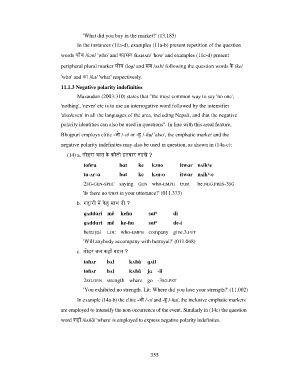
                           Bhojpuri employs clitic -ओ /-o/ or -P /-ɦu/ 'also', the emphatic marker and the

                           negative polarity indefinites may also be used in question, as shown in (14a-c):

                             (14) a. तोहरा बात के कौनो इतवार नइखे ?
                                    toɦrɑ          bɑt     ke    kɔno       itwɑr  nʌikʰe

                                    tu-ʌr-ɑ        bɑt     ke    kɔn-o      itwɑr  nʌikʰ-e
                                    2SG-GEN-SPEC  saying  GEN  who-EMPH  trust      be.NEG.PRES-3SG

                                    'Is there no trust in your utterance?' (011.373)
                                 b.  गQारी म) केR साथ दी ?

                                    ɡʌddɑri  mẽ  keɦu          sɑtʰ      di

                                    ɡʌddɑri  mẽ  ke-ɦu         sɑtʰ      de-i
                                    betrayal   LOC  who-EMPH  company  give.3.FUT
                                    'Will anybody accompany with betrayal?' (011.048)

                                 c.  तोहर बल कहाँ गइल ?

                                    toɦʌr     bʌl      kʌɦɑ ̃   ɡʌil
                                    toɦʌr     bʌl      kʌɦɑ ̃   jɑ  -il
                                    2SG.GEN  strength  where  go  -3SG.PST

                                    'You exhibited no strength. Lit: Where did you lose your strength?' (11.002)

                                 In example (14a-b) the clitic -ओ /-o/ and -P /-ɦu/, the inclusive emphatic markers
                           are employed to intensify the non-occurrence of the event. Similarly in (14c) the question

                           word कहाँ /kʌɦɑ/ 'where' is employed to express negative polarity indefinites.
                                        ̃


                                                                355

