


Page 384 - A GRAMMAR OF BHOJPURI _ PhD Dissertation 2020 TU
P. 384
11.2 Manipulative speech acts
                                 Givόn (2001b:311) considers manipulative speech acts as the verbal acts by

                           which the speaker attempts to get the hearer to act. Givón (2011:305) further states
                           divergence of the manipulative speech acts in terms of the relative power, authority or
                           social position claimed by the speaker vis-a-vis hearer, and that the higher the

                           speaker's position is vis-a-vis the hearer, the more direct or less polite the
                           manipulative speech-act is. The imperative, hortative and optative are the

                           manipulative speech acts found in Bhojpuri, being discussed as follows:
                           11.2.1 Imperative

                                 As Givón (2001b:305) mentions, the bare-stem form of the verb serves as the
                           most direct, least polite, mperative speech-act, often with the last stem-vowel silenced.

                           As attested in Chitoniya Tharu (Paudyal 2013:209), Awadhi (Saksena 1937/1971:268),
                           Maithili (Yadav 1996:285), Hindi (Koul 2008:255) and Nepali (Upadhyay 2010:105
                           and Adhikari 2016:211) to a greater extent, Bhojpuri meets the criteria in similar way

                           (Nirbhik 1975:128, Tripathy 1987:261, Shrivastava 1999:111, Sharma and Ashk
                           2007:73, Thakur 2011:148 and Singh 2013:162). Regarding the subject-manipulee,

                           always a second person singular or plural (i.e. the hearer), is generally expressed by a
                           pronoun but not essential.

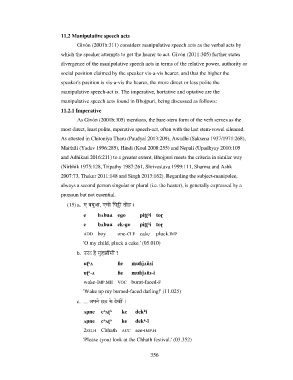
                             (15) a.  ए बबुआ, एगो िपUी तोड़ ।

                                    e     bʌbuɑ  eɡo       piʈʈʰi  toɽ
                                    e     bʌbuɑ  ek-ɡo     piʈʈʰi  toɽ
                                    ADD  boy      one-CLF  cake  pluck.IMP

                                    'O my child, pluck a cake.' (05.010)

                                 b.  उठऽ हे मुहझYसी !
                                    uʈʰʌ          ɦe    muɦȷ ̈ ʌũsi
                                    uʈʰ-ʌ         ɦe    muɦȷ ̈ ʌũs-i

                                    wake-IMP.MH  VOC  burnt-faced-F
                                    'Wake up my burned-faced darling!' (11.025)

                                 c.  ... अपने छठ के देख3 ।

                                    ʌpne  cʰʌʈʰ     ke    dekʰĩ
                                    ʌpne  cʰʌʈʰ     ke    dekʰ-ĩ

                                    2SG.H  Chhath  ACC  see-IMP.H
                                    'Please (you) look at the Chhath festival.' (03.352)


                                                                356

