


Page 382 - A GRAMMAR OF BHOJPURI _ PhD Dissertation 2020 TU
P. 382
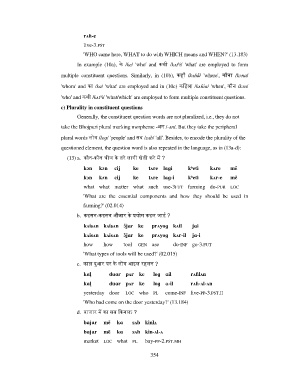
rʌɦ-e
                                    live-3.PST

                                    'WHO came here, WHAT to do with WHICH means and WHEN?' (13.183)
                                 In  example  (10a),  के  /ke/  'who'  and  कथी  /kʌtʰi/  'what'  are  employed  to  form

                           multiple  constituent  questions.  Similarly,  in  (10b),  कहाँ  /kʌɦɑ/  'where',  कौना  /kɔnɑ/
                                                                                    ̃
                           'whom' and का /kɑ/ 'what' are employed and in (10c) किहआ /kʌɦiɑ/ 'when', कौन /kɔn/

                           'who' and कथी /kʌtʰi/ 'what/which' are employed to form multiple constituent questions.

                           c) Plurality in constituent questions
                                 Generally, the constituent question words are not pluralized, i.e., they do not
                           take the Bhojpuri plural marking morpheme -अन /-ʌn/. But they take the peripheral

                           plural words लोग /loɡ/ 'people' and सब /sʌb/ 'all'. Besides, to encode the plurality of the

                           questioned element, the question word is also repeated in the language, as in (13a-d):

                             (13) a.  कौन-कौन चीज के तरे लागी खेती करे म) ?
                                    kɔn   kɔn    cij     ke    tʌre  lɑɡi       kʰeti    kʌre    mẽ

                                    kɔn   kɔn    cij     ke    tʌre  lɑɡ-i      kʰeti    kʌr-e   mẽ
                                    what  what  matter  what  such  use-3FUT  farming  do-PUR  LOC

                                    'What  are  the  essential  components  and  how  they  should  be  used  in
                                    farming?' (02.014)

                                 b.  कइसन-कइसन Mजार के >योग कइल जाई ?
                                    kʌisʌn  kʌisʌn  ɔ ̃ jɑr  ke   prʌyoɡ  kʌil   jɑi

                                    kʌisʌn  kʌisʌn  ɔ ̃ jɑr  ke   prʌyoɡ  kʌr-il  jɑ-i
                                    how     how      tool   GEN  use     do-INF  go-3.FUT

                                    'What types of tools will be used?' (02.015)
                                 c.  का0 दुआर पर के लोग आइल रहलन ?

                                    kɑl̥       duɑr  pʌr  ke     loɡ  ɑil        rʌɦlʌn
                                    kɑl̥       duɑr  pʌr  ke     loɡ  ɑ-il       rʌɦ-ʌl-ʌn

                                    yesterday  door   LOC  who  PL    come-INF  live-PP-3.PST.H
                                    'Who had come on the door yesterday?' (13.184)

                                 d.  बाजार म) का सब ;कनलऽ ?

                                    bɑjɑr  mẽ  kɑ       sʌb  kinlʌ
                                    bɑjɑr  mẽ  kɑ       sʌb  kin-ʌl-ʌ
                                    market  LOC  what  PL     buy-PP-2.PST.MH


                                                                354

