


Page 381 - A GRAMMAR OF BHOJPURI _ PhD Dissertation 2020 TU
P. 381
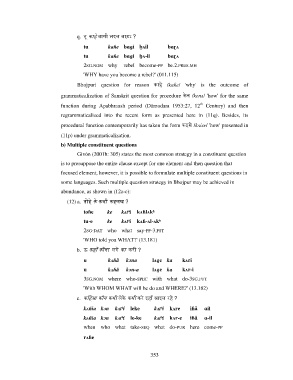
q.  तू काहे बागी भइल बाड़ऽ ?

                                    tu        kɑɦe  bɑɡi  b ̤ ʌil      bɑɽʌ
                                    tu        kɑɦe  bɑɡi  b ̤ ʌ-il     bɑɽʌ
                                    2SG.NOM  why  rebel  become-PP  be.2.PRES.MH

                                    'WHY have you become a rebel?' (011.115)

                                 Bhojpuri  question  for  reason  काहे  /kɑɦe/  'why'  is  the  outcome  of
                           grammaticalization of Sanskrit question for procedure केन /kenʌ/ 'how' for the same

                                                                                     th
                           function  during  Apabhransh  period  (Dāmodara  1953:27,  12   Century)  and  then
                           regrammaticalized  into  the  recent  form  as  presented  here  in  (11q).  Besides,  its
                           procedural function contemporarily has taken the form कइसे /kʌise/ 'how' presented in

                           (11p) under grammaticalization.
                           b) Multiple constituent questions

                                 Givόn (2001b: 305) states the most common strategy in a constituent question
                           is to presuppose the entire clause except for one element and then question that
                           focused element, however, it is possible to formulate multiple constituent questions in

                           some languages. Such multiple question strategy in Bhojpur may be achieved in
                           abundance, as shown in (12a-c):

                             (12) a.  तोहे के कथी  कहलख ?

                                    toɦe      ke    kʌtʰi  kʌɦlʌkʰ
                                    tu-e      ke    kʌtʰi  kʌɦ-ʌl-ʌkʰ

                                    2SG-DAT  who  what  say-PP-3.PST
                                    'WHO told you WHAT?' (13.181)

                                 b.  ऊ कहाँ कौना  लगे का  करी ?
                                    u         kʌɦɑ  ̃  kɔnɑ      lʌɡe  kɑ    kʌri

                                    u         kʌɦɑ  ̃  kɔn-ɑ     lʌɡe  kɑ    kʌr-i
                                    3SG.NOM  where  who-SPEC  with  what  do-3SG.FUT
                                    'With WHOM WHAT will he do and WHERE?' (13.182)

                                 c.  किहआ कौन कथी लेके कथी करे इहाँ आइल रहे ?

                                    kʌɦiɑ  kɔn  kʌtʰi  leke      kʌtʰi  kʌre    iɦɑ ̃   ɑil
                                    kʌɦiɑ  kɔn  kʌtʰi  le-ke     kʌtʰi  kʌr-e   iɦɑ ̃   ɑ-il

                                    when  who  what  take-SEQ  what  do-PUR  here  come-PP

                                    rʌɦe


                                                                353

