


Page 378 - A GRAMMAR OF BHOJPURI _ PhD Dissertation 2020 TU
P. 378
element of the question, representing the crucial piece of new information that is being
requested" (Kroeger 2005:205). "Wh-questions (also called constituent questions)
may be then the focus of being either of the subject, object, verb, predicate, adverb,
indirect object, time, place, manner, reason etc" (Givón 2001b:300).
a) Single constituent questions
Bhojpuri employs the interrogative question words to encode different types of
constituent questions normally for a single inquiry: के /ke/ or कौन /kɔn/ 'who', के के /ke
ke/ or केकरा के /kekrɑ ke/ 'whom', का /kɑ/ or कथी /kʌtʰi/ 'what or which', केकर /kekʌr/
or ;कनकर /kinkʌr/ 'whose', कतेक /kʌtek/ or केतना /ketnɑ/ 'how much/many', कै /kɛ/ 'how
many', कब /kʌb/ or किहआ /kʌɦiɑ/ 'when', कहाँ /kʌɦɑ/ or केने /kene/ 'where', कइसन
̃
/kʌisʌn/ or कइसे /kʌise/ 'how' and काहे /kɑɦe/ 'why'.
Most languages use one of two basic strategies: either the questionword
appears at the beginning of the sentence, as in English, to be called "Wh-fronting" or
the question word appears in the place where the constituent which it replaces would
normally occur in a declarative sentence, to be called in situ 'in place' (Kroeger
2005:205). Bhojpuri falls in the second category. Some of the single constituent
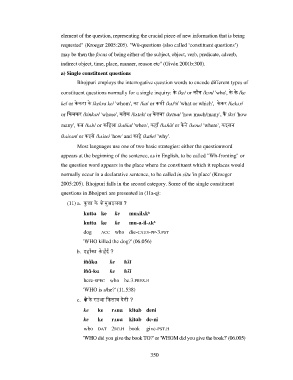
questions in Bhojpuri are presented in (11a-q):
(11) a. कुFा के के मुअइलख ?
kuttɑ ke ke muʌilʌkʰ
kuttɑ ke ke mu-ɑ-il-ʌkʰ
dog ACC who die-CAUS-PP-3.PST
'WHO killed the dog?' (06.056)
b. इहाँका के हँG ?
iɦɑ ̃ kɑ ke ɦʌ ̃ ĩ
iɦɑ ̃ -kɑ ke ɦʌ ̃ ĩ
here-SPEC who be.3.PRES.H
'WHO is s/he?' (11.538)
c. के के रउआ ;कताब देनी ?
ke ke rʌuɑ kitɑb deni
ke ke rʌuɑ kitɑb de-ni
who DAT 2SG.H book give-PST.H
'WHO did you give the book TO?' or 'WHOM did you give the book?' (06.005)
350

