


Page 358 - A GRAMMAR OF BHOJPURI _ PhD Dissertation 2020 TU
P. 358
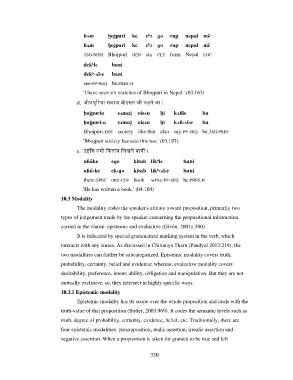
ɦʌm       b ̤ ojpuri  ke   cʰɔ  ɡo   rup   nepɑl  mẽ
                                    ɦʌm       b ̤ ojpuri  ke   cʰɔ  ɡo   rup   nepɑl  mẽ

                                    1SG.NOM  Bhojpuri  GEN  six  CLF  form  Nepal  LOC

                                    dekʰle      bɑni
                                    dekʰ-ʌl-e   bɑni
                                    see-PP-SEQ  be.PRES.H

                                    'I have seen six varieties of Bhojpuri in Nepal.' (03.163)
                                 d.  भोजपुKरया समाज ओइसन भी कहले बा ।

                                    b ̤ ojpuriɑ   sʌmɑj  oisʌn      b ̤ i   kʌɦle     bɑ
                                    b ̤ ojpuri-ɑ   sʌmɑj  oisʌn     b ̤ i   kʌɦ-ʌl-e   bɑ

                                    Bhojpuri-DEF  society  like that  also  say-PP-SEQ  be.3SG.PRES
                                    'Bhojpuri society has said this too.' (03.197)

                                 e.  उहाँके एगो >कताब िलखले बानी ।

                                    uɦɑ ̃ ke    eɡo      kitɑb  likʰle        bɑni
                                    uɦɑ ̃ -ke   ek-ɡo    kitɑb  likʰ-ʌl-e     bɑni
                                    there-SPEC  one-CLF  book  write-PP-SEQ  be.PRES.H

                                    'He has written a book.' (04.104)
                           10.3 Modality

                                 The modality codes the speaker's attitute toward proposition, primarily two
                           types of judgement made by the speaker concerning the propositional information
                           carried in the clause: epistemic and evaluative (Givón, 2001a:300).

                                 It is indicated by special grammatical marking system in the verb, which
                           interacts with any tenses. As discussed in Chitoniya Tharu (Paudyal 2013:219), the

                           two modalities can further be subcategorized. Epistemic modality covers truth,
                           probability, certainty, belief and evidence; whereas, evaluative modality covers

                           desirability, preference, intent, ability, obligation and manipulation. But they are not
                           mutually exclusive, so, they intersect in highly specific ways.

                           10.3.1 Epistemic modality
                                 Epistemic modality has its scope over the whole proposition and deals with the
                           truth-value of that proposition (Butler, 2003:969). It codes the semantic levels such as

                           truth, degree of probability, certainty, evidence, belief, etc. Traditionally, there are
                           four epistemic modalities: presupposition, realis assertion, irrealis assertion and

                           negative assertion. When a proposition is taken for granted to be true and left


                                                                330

