


Page 353 - A GRAMMAR OF BHOJPURI _ PhD Dissertation 2020 TU
P. 353
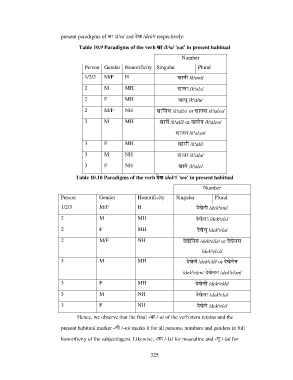
present paradigms of खा /kʰɑ/ and देख /dekʰ/ respectively:

                                  Table 10.9 Paradigms of the verb खा /kʰɑ/ 'eat' in present habitual
                                                                             Number

                                    Person  Gender  Honorificity  Singular          Plural

                                    1/2/3    M/F     H                     खानी /kʰɑni/
                                    2        M       MH                    खालऽ /kʰɑlʌ/

                                    2        F       MH                     खालू /kʰɑlu/

                                    2        M/F     NH           खािलस /kʰɑlis/ or खालस /kʰɑlʌs/

                                    3        M       MH             खाल& /kʰɑlẽ/ or खालेन /kʰɑlen/

                                                                          खालन /kʰʌlʌn/

                                    3        F       MH                    खाली /kʰɑli/

                                    3        M       NH                    खाला /kʰɑlɑ/

                                    3        F       NH                     खाले /kʰɑle/

                                 Table 10.10 Paradigms of the verb देख /dekʰ/ 'see' in present habitual
                                                                                      Number

                           Person          Gender          Honorificity    Singular        Plural
                           1/2/3           M/F             H                       देखेनी /dekʰeni/

                           2               M               MH                      देखेलऽ /dekʰelʌ/

                           2               F               MH                      देखेलू /dekʰelu/

                           2               M/F             NH                 देखेिलस /dekʰelis/ or देखेलस

                                                                                     /dekʰelʌs/

                           3               M               MH                  देखेल& /dekʰelẽ/ or देखेलेन
                                                                             /dekʰelen/ देखेलन /dekʰelʌn/

                           3               F               MH                      देखेली /dekʰekli/

                           3               M               NH                      देखेला /dekʰelɑ/

                           3               F               NH                      देखेले /dekʰele/

                                 Hence, we observe that the final -आ /-ɑ/ of the verb stem retains and the

                           present habitual marker -नी /-ni/ marks it for all persons, numbers and genders in full

                           honorificity of the subject/agent. Likewise, -लऽ /-lʌ/ for masculine and -लू /-lu/ for


                                                                325

