


Page 356 - A GRAMMAR OF BHOJPURI _ PhD Dissertation 2020 TU
P. 356
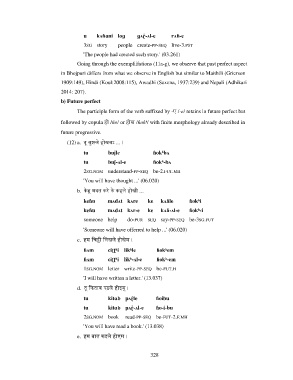
u    kʌɦɑni  loɡ      ɡʌɽ ̊ -ʌl-e    rʌɦ-e
                                    3SG  story    people  create-PP-SEQ  live-3.PST

                                    'The people had created such story.' (03.261)
                                 Going through the exempliifations (11a-g), we observe that past perfect aspect
                           in Bhojpuri differs from what we observe in English but similar to Maithili (Grierson

                           1909:149), Hindi (Koul:2008:115), Awadhi (Saxena, 1937:239) and Nepali (Adhikari
                           2014: 207).

                           b) Future perfect
                                 The participle form of the verb suffixed by -ए /-e/ retains in future perfect but

                           followed by copula हो /ɦo/ or होख /ɦokʰ/ with finite morphology already described in

                           future progressive.

                             (12) a.  तू बुझले होखबऽ ... ।
                                    tu        buȷ ̈ le           ɦokʰbʌ

                                    tu        buȷ ̈ -ʌl-e        ɦokʰ-bʌ
                                    2SG.NOM  understand-PP-SEQ  be-2.FUT.MH
                                    'You will have thought ...' (06.020)

                                 b.  केi मदत करे के कहले होखी ...

                                    keɦu      mʌdʌt  kʌre      ke   kʌɦle       ɦokʰi
                                    keɦu      mʌdʌt  kʌr-e     ke   kʌɦ-ʌl-e    ɦokʰ-i

                                    someone  help     do-PUR  SEQ  say-PP-SEQ  be-3SG.FUT

                                    'Someone will have offerred to help ...' (06.020)
                                 c.  हम िचjी िलखले होखेम ।

                                    ɦʌm       ciʈʈʰi  likʰle      ɦokʰem
                                    ɦʌm       ciʈʈʰi  likʰ-ʌl-e   ɦokʰ-em

                                    1SG.NOM  letter  write-PP-SEQ  be-FUT.H
                                    'I will have written a letter.' (13.037)
                                 d.  तू >कताब पढ़ले होइबू ।

                                    tu        kitɑb  pʌɽ ̊ le     ɦoibu

                                    tu        kitɑb  pʌɽ ̊ -ʌl-e   ɦo-i-bu
                                    2SG.NOM  book  read-PP-SEQ  be-FUT-2.F.MH
                                    'You will have read a book.' (13.038)

                                 e.  हम बात कइले होएम ।


                                                                328

