


Page 344 - A GRAMMAR OF BHOJPURI _ PhD Dissertation 2020 TU
P. 344
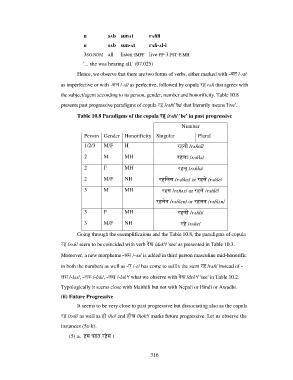
u         sʌb  sunʌt       rʌɦli
                                    u         sʌb  sun-ʌt      rʌɦ-ʌl-i

                                    3SG.NOM  all   listen-IMPF  live-PP-3.PST-F.MH
                                    '... she was hearing all.' (07.025)

                                 Hence, we observe that there are two forms of verbs, either marked with -अत /-ʌt/

                           as imperfective or with -अल /-ʌl/ as perfective, followed by copula रह rʌɦ that agrees with
                           the subject/agent according to its person, gender, number and honorificity. Table 10.8

                           presents past progressive paradigms of copula रह /rʌɦ/ 'be' that literarily means 'live'.

                                 Table 10.8 Paradigms of the copula रह /rʌɦ/ 'be' in past progressive
                                                                             Number

                                    Person  Gender  Honorificity  Singular          Plural
                                    1/2/3   M/F      H                     रहनी /rʌɦnĩ/

                                    2       M        MH                    रहलऽ /rʌɦlʌ/

                                    2       F        MH                    रहलू /rʌɦlu/

                                    2       M/F      NH            रहिलस /rʌɦlis/ or रहले /rʌɦle/

                                    3       M        MH              रहस /rʌɦʌs/ or रहल& /rʌɦlẽ/

                                                                  रहलेन /rʌɦlen/ or रहलन /rʌɦlʌn/

                                    3       F        MH                    रहली /rʌɦli/

                                    3       M/F      NH                      रहे /rʌɦe/
                                 Going through the exemplificaions and the Table 10.8, the paradigms of copula

                           रह /rʌɦ/ seem to be coincided with verb देख /dekʰ/ 'see' as presented in Table 10.3.

                           Moreover, a new morpheme -अस /-ʌs/ is added in third person masculine mid-honorific
                           in both the numbers as well as -ए /-e/ has come to suffix the stem रह /rʌɦ/ instead of -


                           लस /-lʌs/, -लक /-lʌk/, -लख /-lʌkʰ/ what we observe with देख /dekʰ/ 'see' in Table 10.2.
                           Typologically it seems close with Maithili but not with Nepali or Hindi or Awadhi.

                           (ii) Future Progressive
                                 It seems to be very close to past progressive but dissociating also as the copula

                           रह /rʌɦ/ as well as हो /ɦo/ and होख /ɦokʰ/ marks future progressive. Let us observe the
                           instances (5a-k).

                              (5) a.  हम पढ़त रहेम ।


                                                                316

