


Page 340 - A GRAMMAR OF BHOJPURI _ PhD Dissertation 2020 TU
P. 340
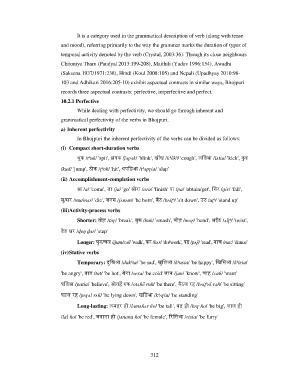
It is a category used in the grammatical description of verb (along with tense
                           and mood), referring primarily to the way the grammar marks the duration of types of

                           temporal activity denoted by the verb (Crystal, 2003:36). Though its close neighbours
                           Chitoniya Tharu (Paudyal 2013:199-208), Maithili (Yadav 1996:154), Awadhi
                           (Saksena 1937/1971:238), Hindi (Koul 2008:105) and Nepali (Upadhyay 2010:98-

                           103 and Adhikari 2016:205-10) exhibit aspectual contrasts in similar ways, Bhojpuri
                           records three aspectual contrasts: perfective, imperfective and perfect.

                           10.2.1 Perfective
                                 While dealing with perfectivity, we should go through inherent and

                           grammatical perfectivity of the verbs in Bhojpuri.
                           a) Inherent perfectivity

                                 In Bhojpuri the inherent perfectivity of the verbs can be divided as follows:
                           (i)  Compact short-duration verbs

                                 थुक /tʰuk/ 'spit', झपक /ȷ ̈ ʌpʌk/ 'blink', खHख /kʰõkʰ/ 'cough', लितआ /lʌtiɑ/ 'kick', कुद
                           /kud/ 'jump', ठोक /ʈʰok/ 'hit', थपिड़आ /tʰʌpɽiɑ/ 'slap'

                           (ii) Accomplishment-completion verbs
                                 आ /ɑ/ 'come', जा /jɑ/ 'go' ओरा /orɑ/ 'finish' पा /pɑ/ 'obtain/get', िगर /ɡir/ 'fall',


                           मु/मर /mu/mʌr/ 'die', जनम /jʌnʌm/ 'be born', बैठ /bʌiʈʰ/ 'sit down', उठ /uʈʰ/ 'stand up'
                           (iii)Activity-process verbs

                                 Shorter: तोड़ /toɽ/ 'break', बुक /buk/ 'smash', मोड़ /moɽ/ 'bend', अइँठ /ʌĩʈʰ/ 'twist',

                           डेङ धर /ɖeŋ d ̤ ʌr/ 'step'
                                 Longer: घुम/चल /ɡ ̈ um/cʌl/ 'walk', कर /kʌr/ 'do/work', पढ़ /pʌɽ ̊ / 'read', नाच /nɑc/ 'dance'

                           (iv) Stative verbs

                                 Temporary: दुिखआ /dukʰiɑ/ 'be sad', खुिशआ /kʰusiɑ/ 'be happy', िखिसआ /kʰisiɑ/
                           'be angry', तात /tɑt/ 'be hot', सेरा /serɑ/ 'be cold' जान /jɑn/ 'know', चाह /cɑɦ/ 'want'

                           पितआ /pɑtiɑ/ 'believe', ओतह& Jक /otʌɦẽ ruk/ 'be there', बैठल रह /bʌiʈʰʌl rʌɦ/ 'be sitting'

                           पड़ल रह /pʌɽʌl rʌɦ/ 'be lying down', खिड़आ /kʰʌɽiɑ/ 'be standing'

                                 Long-lasting: लमहर हो /lʌmʌɦʌr ɦo/ 'be tall', बड़ हो /bʌɽ ɦo/ 'be big', लाल हो

                           /lɑl ɦo/ 'be red', जनाना हो /jʌnanɑ ɦo/ 'be female', Kरिसआ /risiɑ/ 'be furry'


                                                                312

