


Page 336 - A GRAMMAR OF BHOJPURI _ PhD Dissertation 2020 TU
P. 336
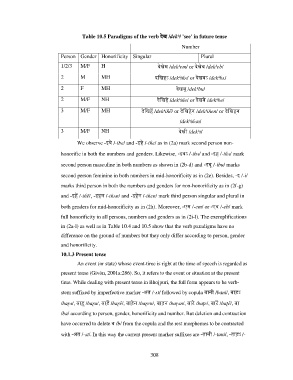
Table 10.5 Paradigms of the verb देख /dekʰ/ 'see' in future tense

                                                                             Number
                           Person  Gender  Honorificity  Singular                    Plural

                           1/2/3   M/F     H                       देखेम /dekʰem/ or देखेब /dekʰeb/

                           2       M       MH                     दिखहऽ /dekʰiɦʌ/ or देखबऽ /dekʰbʌ/
                           2       F       MH                              देखबू /dekʰbu/

                           2       M/F     NH                      देिखहे /dekʰiɦe/ or देखबे /dekʰbe/

                           3       M/F     MH               देिखह& /dekʰiɦẽ/ or देिखहेन /dekʰiɦen/ or देिखहन

                                                                            /dekʰiɦʌn/

                           3       M/F     NH                               देखी /dekʰi/

                                 We observe -इबे /-ibe/ and -इहे /-iɦe/ as in (2a) mark second person non-

                           honorific in both the numbers and genders. Likewise, -इबऽ /-ibʌ/ and -इह /-iɦʌ/ mark
                           second person masculine in both numbers as shown in (2b-d) and -इबू /-ibu/ marks

                           second person feminine in both numbers in mid-honorificity as in (2e). Besides, -इ /-i/

                           marks third person in both the numbers and genders for non-honorificity as in (2f-g)
                           and -इह& /-iɦẽ/, -इहन /-iɦʌn/ and -इहेन /-iɦen/ mark third person singular and plural in

                           both genders for mid-honorificity as in (2h). Moreover, -एम /-em/ or -एब /-eb/ mark

                           full honorificity in all persons, numbers and genders as in (2i-l). The exemplifications
                           in (2a-l) as well as in Table 10.4 and 10.5 show that the verb paradigms have no

                           difference on the ground of numbers but they only differ according to person, gender
                           and honorificity.

                           10.1.3 Present tense
                                 An event (or state) whose event-time is right at the time of speech is regarded as

                           present tense (Givón, 2001a:286). So, it refers to the event or situation at the present
                           time. While dealing with present tense in Bhojpuri, the full form appears to be verb-

                           stem suffixed by imperfective marker -अत /-ʌt/ followed by copula बानी /bɑni/, बाड़ऽ
                           /bɑɽʌ/, बाड़ू /bɑɽu/, बाड़& /bɑɽẽ/, बाड़ेन /bɑɽen/, बाड़न /bɑɽʌn/, बाटे /bɑʈe/, बाट& /bɑʈẽ/, बा

                           /bɑ/ according to person, gender, honorificity and number. But deletion and contraction

                           have occurred to delete ब /b/ from the copula and the rest morphemes to be contracted

                           with -अत /-ʌt/. In this way the current present marker suffixes are -तानी /-tɑni/, -ताड़ऽ /-


                                                                308

