


Page 333 - A GRAMMAR OF BHOJPURI _ PhD Dissertation 2020 TU
P. 333
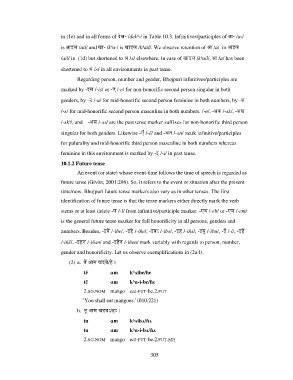
in (1e) and in all forms of देख- /dekʰ-/ in Table 10.3. Infinitives/participles of आ- /ɑ-/
                           is आइल /ɑil/ and खा- /kʰɑ-/ is खाइल /kʰɑil/. We observe retention of आ /ɑ/  in आइल


                           /ɑil/ in  (1d) but shortened to अ /ʌ/ elsewhere. In case of खाइल /kʰɑil/, आ /ɑ/ has been

                           shortened to अ /ʌ/ in all environments in past tense.
                                 Regarding person, number and gender, Bhojpuri infinitives/participles are

                           marked by -इस /-is/ or -ए /-e/ for non-honorific second person singular in both
                           genders, by -उ /-u/ for mid-honorific second person feminine in both numbers, by -अ

                           /-ʌ/ for mid-honorific second person masculine in both numbers. /-ø/, -अक /-ʌk/, -अख

                           /-ʌkʰ/, and    -अस /-ʌs/ are the past tense marker suffixes for non-honorific third person

                           singular for both genders. Likewise -एँ /-ẽ/ and -अन /-ʌn/ mark infinitive/participles

                           for pulurality and mid-honorific third person masculine in both numbers whereas
                           feminine in this environment is marked by -इ /-i/ in past tense.

                           10.1.2 Future tense
                                 An event (or state) whose event-time follows the time of speech is regarded as

                           future tense (Givón, 2001:286). So, it refers to the event or situation after the present
                           time/now. Bhojpuri future tense markers also vary as in other tenses. The first

                           identification of future tense is that the tense markers either directly mark the verb
                           stems or at least delete -ल /-l/ from infinitive/participle marker. -एब /-eb/ or -एम /-em/

                           is the general future tense marker for full honorificity in all persons, genders and

                           numbers. Besides, -इबे /-ibe/, -इहे /-iɦe/, -इबऽ /-ibʌ/, -इह /-iɦʌ/, -इबू /-ibu/, -ई /-i/, -इह&
                           /-iɦẽ/, -इहन /-iɦʌn/ and -इहेन /-iɦen/ mark variably with regards to person, number,

                           gender and honorificity. Let us observe exemplifications in (2a-l).
                              (2) a.  त& आम खइबे/हे ।

                                    tẽ         ɑm      kʰʌibe/ɦe

                                    tẽ         ɑm      kʰɑ-i-be/ɦe
                                    2.SG.NOM  mango  eat-FUT-be.2.FUT

                                    'You shall eat mangoes.' (010.221)
                                 b.  तू आम खइबऽ/हऽ ।

                                    tu         ɑm      kʰʌibʌ/ɦʌ

                                    tu         ɑm      kʰɑ-i-bʌ/ɦʌ
                                    2.SG.NOM  mango  eat-FUT-be.2.FUT.MH


                                                                305

