


Page 328 - A GRAMMAR OF BHOJPURI _ PhD Dissertation 2020 TU
P. 328
CHAPTER 10
                                                TENSE, ASPECT AND MODALITY

                           10.0  Outline
                                 This chapter deals with the functional organization of one of the most complex
                           grammatical subsystems; tense, aspect and modality (henceforth TAM) in Bhojpuri. It

                           consists of five sections. Section 10.1 deals with tense. In section 10.2 we analyze
                           aspects in Bhojpuri. Section 10.3 presents modality and section 10.4 analyzes mood

                           and we summarize the findings in the chapter in section 10.5.
                            10.1 Tense

                                 Comrie (1985:9) describes tense as grammaticalized expression of location in
                           time. Likewise, Payne (1997:233) expresses that tense is associated with sequence of

                           events in real time. Masica (1991:279) notes that the real tenses are present and past,
                           to which future may be added.
                                 Tense involves the systematic coding of the relation between two points along

                           the ordered linear dimension of time: reference time and event time (Givón, 2001:285),
                           describing the time of speech as the unmarked ('default') temporal reference point vis-a-

                           a-vis which event/state calauses are anchored with. Temporal anchoring to this default
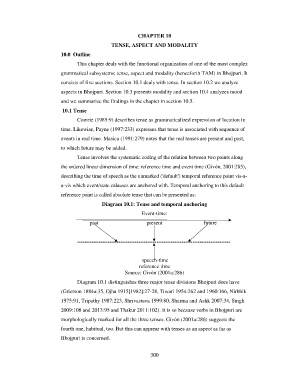
                           reference point is called absolute tense that can be presented as:

                                            Diagram 10.1: Tense and temporal anchoring
                                                            Event-time:

                                       past                   present                 future

                                 -------------------------------------------------------------------------------------


                                                            speech-time
                                                           reference time
                                                     Source: Givón (2001a:286)

                                 Diagram 10.1 distinguishes three major tense divisions Bhojpuri does have
                           (Grierson 1884a:35, Ojha 1915[1982]:27-28, Tiwari 1954:262 and 1960:166, Nirbhik

                           1975:91, Tripathy 1987:223, Shrivastava 1999:80, Sharma and Ashk 2007:34, Singh
                           2009:108 and 2013:95 and Thakur 2011:102). It is so because verbs in Bhojpuri are

                           morphologically marked for all the three tenses. Givón (2001a:286) suggests the
                           fourth one, habitual, too. But this can apprear with tenses as an aspect as far as

                           Bhojpuri is concerned.


                                                                300

