


Page 330 - A GRAMMAR OF BHOJPURI _ PhD Dissertation 2020 TU
P. 330
As displayed in Chitoniya Tharu (Paudyal 2013:194), Maithili (Yadav
                           1996:217), Awadhi (Saksena 1937/1971:238), Hindi (Koul 2008:105) and Nepali

                           (Upadhyay 2010:93 and Adhikari 2016:199), Bhojpuri has three tense system: past,
                           future and present.

                           10.1.1 Past tense
                                 An event (or state) whose event-time proceeds the time of speech is regarded
                           as past tense. The past tense in Bhojpuri is marked differently according to the person,

                           number, gender and honorificity. For past tense, participle forms of verbs are used but
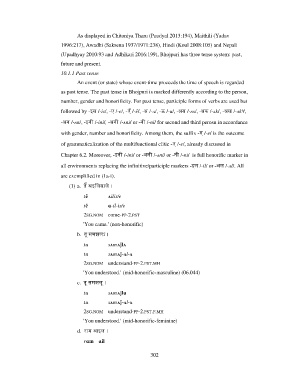
                           followed by -इस /-is/, -ए /-e/, -एँ /-ẽ/, -अ /-ʌ/, -ऊ /-u/, -अस /-ʌs/, -अक /-ʌk/, -अख /-ʌkʰ/,

                           -अन /-ʌn/, -इनी /-ini/, -अनी /-ʌni/ or -नी /-ni/ for second and third perosn in accordance

                           with gender, number and honorificity. Among them, the suffix -ए /-e/ is the outcome

                           of grammaticalization of the multifunctional clitic -ए /-e/, already discussed in

                           Chapter 6.2. Moreover, -इनी /-ini/ or -अनी /-ʌni/ or -नी /-ni/  is full honorific marker in

                           all environments replacing the infinitive/participle markers -इल /-il/ or -अल /-ʌl/. All
                           are exemplified in (1a-i).

                              (1) a.  तेँ अइिलस/ले ।

                                    tẽ        ʌilis/e
                                    tẽ        ɑ-il-is/e

                                    2SG.NOM  come-PP-2.PST
                                    'You came.' (non-honorific)
                                 b.  तू समझलऽ ।

                                    tu        sʌmʌȷ ̈ lʌ

                                    tu        sʌmʌȷ ̈ -ʌl-ʌ
                                    2SG.NOM  understand-PP-2.PST.MH
                                    'You understood.' (mid-honorific-masculine) (06.044)

                                 c.  तू समझलू ।

                                    tu        sʌmʌȷ ̈ lu
                                    tu        sʌmʌȷ ̈ -ʌl-u

                                    2SG.NOM  understand-PP-2.PST.F.MH
                                    'You understood.' (mid-honorific-feminine)

                                 d.  राम आइल ।
                                    rɑm  ɑil


                                                                302

