


Page 324 - A GRAMMAR OF BHOJPURI _ PhD Dissertation 2020 TU
P. 324
complement clause occurs in the usual subject position and the object complement
                                                           5
                           clause occurs in the object position.
                           9.2.4 Order of bound morphemes
                                 This sub-section deals with the order of bound morphemes in Bhojpuri. First,
                           we examine the bound morphemes related to nominal morphology. Then, the order of

                           tense, aspect and modal morphemes is taken into consideration. Lastly, we discuss the
                           place of negative morphemes in Bhojpuri.

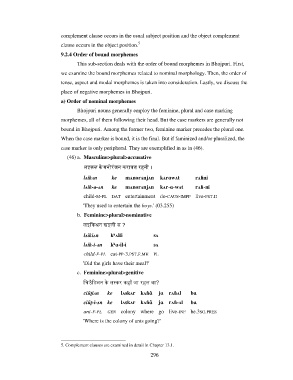
                           a) Order of nominal morphemes
                                 Bhojpuri nouns generally employ the feminine, plural and case marking

                           morphemes, all of them following their head. But the case markers are generally not
                           bound in Bhojpuri. Among the former two, feminine marker precedes the plural one.

                           When the case marker is bound, it is the final. But if faminized and/or pluralized, the
                           case marker is only peripheral. They are exemplified in as in (46).
                             (46) a.  Masculine>plural>accusative

                                    लइकन के मनोरंजन करावत रहनी ।

                                    lʌikʌn      ke   mʌnorʌnjʌn  kʌrɑwʌt           rʌɦni
                                    lʌik-ɑ-ʌn   ke   mʌnorʌnjʌn  kʌr-ɑ-wʌt         rʌɦ-ni

                                    child-M-PL  DAT  entertainment  do-CAUS-IMPF  live-PST.H
                                    'They used to entertain the boys.' (03.255)

                                 b.  Feminine>plural>nominative
                                    लइPकअन खइली स ?

                                    lʌikiʌn    kʰʌili            sʌ
                                    lʌik-i-ʌn   kʰɑ-il-i         sʌ

                                    child-F-PL  eat-PP-3.PST.F.MH  PL
                                    'Did the girls have their meal?'
                                 c.  Feminine>plural>genitive

                                    िचउँGटअन के लdकर कहाँ जा रहल बा?

                                    ciũʈiʌn   ke    lʌskʌr  kʌɦɑ ̃   jɑ  rʌɦʌl   bɑ
                                    ciũʈ-i-ʌn  ke   lʌskʌr  kʌɦɑ ̃   jɑ  rʌɦ-ʌl   bɑ

                                    ant-F-PL   GEN  colony  where  go  live-INF  be.3SG.PRES
                                    'Where is the colony of ants going?'


                           5. Complement clauses are examined in detail in Chapter 13.1.
                                                                296

