


Page 322 - A GRAMMAR OF BHOJPURI _ PhD Dissertation 2020 TU
P. 322
c) Word order in the adverbial phrase
                                 As Hindi (Koul 2008:176-9) and Nepali (Adhikari 2016:316-7) exhibit, we

                           discuss the word order in adverbial phrases in Bhojpuri as follows:
                           (i) Order of the manner adverb and verb
                                 Dryer (2008: 15) asserts that there is a strong crosslinguistic tendency for manner

                           adverbs in OV languages to precede the verb. In line with the usual order of manner
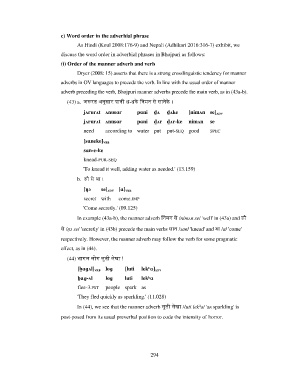
                           adverb preceding the verb, Bhojpuri manner adverbs precede the main verb, as in (43a-b).

                             (43) a.  जqरत अनुसार पानी ध-धके िनमन से सानेके ।

                                    jʌrurʌt  ʌnusɑr       pɑni  d ̤ ʌ   d ̤ ʌke   [nimʌn  se] ADV
                                    jʌrurʌt  ʌnusɑr       pɑni  d ̤ ʌr  d ̤ ʌr-ke  nimʌn  se

                                    need     according to  water  put  put-SEQ  good     SPEC

                                    [sɑneke] VRB
                                    sɑn-e-ke
                                    knead-PUR-SEQ

                                    'To knead it well, adding water as needed.' (13.159)
                                 b.  ङौ से आ ।

                                    [ŋɔ    se] ADV  [ɑ] VRB
                                    secret  with   come.IMP

                                    'Come secretly.' (09.125)
                                 In example (43a-b), the manner adverb िनमन से /nimʌn se/ 'well' in (43a) and ङौ

                           से /ŋɔ se/ 'secretly' in (43b) precede the main verbs सान /sɑn/ 'knead' and आ /ɑ/ 'come'

                           respectively. However, the manner adverb may follow the verb for some pragmatic
                           effect, as in (44).

                             (44) भागल लोग लुती लेखा !

                                 [b ̤ ɑɡʌl] VRB  loɡ   [luti   lekʰɑ] ADV
                                 b ̤ ɑɡ-ʌl   loɡ     luti   lekʰɑ
                                 flee-3.PST  people  spark  as

                                 'They fled quickly as sparkling.' (11.028)
                                 In (44), we see that the manner adverb लुती लेखा /luti lekʰɑ/ 'as sparkling' is

                           post-posed from its usual preverbal position to code the intensity of horror.


                                                                294

