


Page 320 - A GRAMMAR OF BHOJPURI _ PhD Dissertation 2020 TU
P. 320
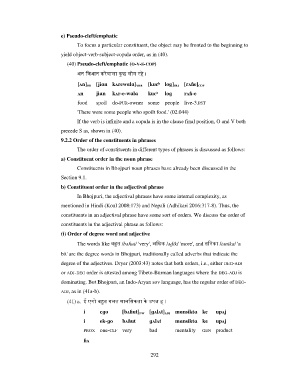
e) Pseudo-cleft/emphatic
                                 To focus a particular constituent, the object may be fronted to the beginning to

                           yield object-verb-subject-copula order, as in (40).
                             (40) Pseudo-cleft/emphatic (O-V-S-COP)

                                 अन िजआन करेवाला कुछ लोग रहे ।
                                 [ʌn] DO  [jiɑn  kʌrewɑlɑ] VRB  [kucʰ  loɡ] SBJ  [rʌɦe] COP

                                 ʌn      jiɑn  kʌr-e-wɑlɑ      kucʰ  loɡ      rʌɦ-e
                                 food    spoil  do-PUR-owner  some  people  live-3.PST

                                 'There were some people who spoilt food.' (02.044)
                                 If the verb is infinite and a copula is in the clause final position, O and V both

                           precede S as, shown in (40).
                           9.2.2 Order of the constituents in phrases
                                 The order of constituents in different types of phrases is discussed as follows:

                           a) Constituent order in the noun phrase
                                 Constituents in Bhojpuri noun phrases have already been discussed in the

                           Section 9.1.
                           b) Constituent order in the adjectival phrase

                                 In Bhojpuri, the adjectival phrases have some internal complexity, as
                           mentioned in Hindi (Koul 2008:173) and Nepali (Adhikari 2016:317-8). Thus, the

                           constituents in an adjectival phrase have some sort of orders. We discuss the order of
                           constituents in the adjectival phrase as follows:
                           (i) Order of degree word and adjective

                                 The words like ब`त /bʌɦut/ 'very', अिधक /ʌd ̤ ik/ 'more', and तिनका /tʌnikɑ/ 'a

                           bit' are the degree words in Bhojpuri, traditionally called adverbs that indicate the
                           degree of the adjectives. Dryer (2003:43) notes that both orders, i.e., either DEG-ADJ
                           or ADJ-DEG order is attested among Tibeto-Burman languages where the DEG-ADJ is

                           dominating. But Bhojpuri, an Indo-Aryan sov language, has the regular order of DEG-
                           ADJ, as in (41a-b).

                             (41) a.  ई एगो ब`त गलत मानिसकता के उपज ह ।

                                    i      eɡo      [bʌɦut] DW  [ɡʌlʌt] ADJ  mɑnsiktɑ  ke   upʌj
                                    i      ek-ɡo    bʌɦut      ɡʌlʌt      mɑnsiktɑ  ke     upʌj

                                    PROX  one-CLF  very        bad        mentality   GEN  product

                                    ɦʌ

                                                                292

